Hercules
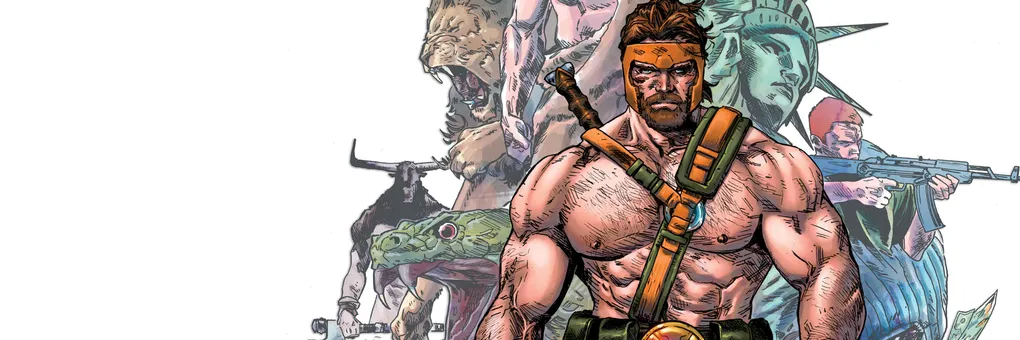
I’ve always loved History. At 10, I wanted to be an archaeologist. My trip to Greece remains one of the highlights of my life. So I approached this pack with caution, afraid I’d end up with a Canada Dry version of my favorite ambrosia. Oh boy, was I wrong. Marvel’s Hercules is the ultimate greek geekery read.
Fast-paced? ✓ Humor? ✓ Creative? ✓ Gorgeous art? ✓
Hot Greek godhood? ✓✓.

Fair warning: this article may get exhausting because I’m going to be very enthusiastic about this pack. It’s also the first pack designed by Frank Brooks, bringing a fresh design sensibility and new inspiration to the table. This adaptation is loyal to the Greg’s Pak “The Incredible Hercules” which immediately follows the events of Civil War, the main theme of Hercules’ wave.
So pour yourself some Dyonysos’ wine, “sext” your muse to clear your evening, and read on!
Hercules
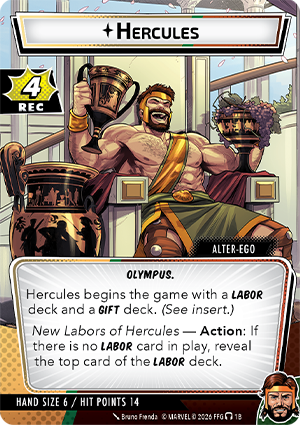
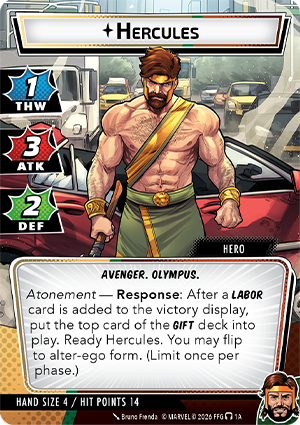
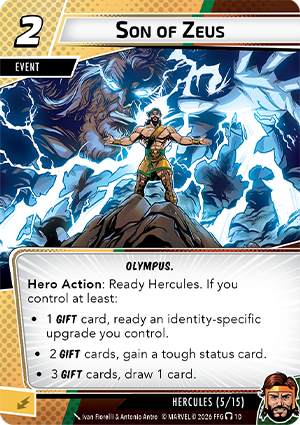
Born of a mortal woman and Zeus, king of the Olympian pantheon, Hercules (Herakles in greek) bridges the divine and human worlds. The writers have followed classical mythology with surprising fidelity, making these stories both accessible and genuinely fun. From his very first appearance in 1945, Hercules has been a delightfully goofy read, brimming with anachronisms and playful analogies that evoke Monty Python or Astérix.
The demigod is an unapologetic party animal whose love of drink and revelry invariably lands him in spectacular trouble. Frank decided to give Hercules a ton of hit points, and incredible attack, which conveys the message that he is not made of the same wood as us, mere mortals. His weak thwart is on point as well.
The Labors
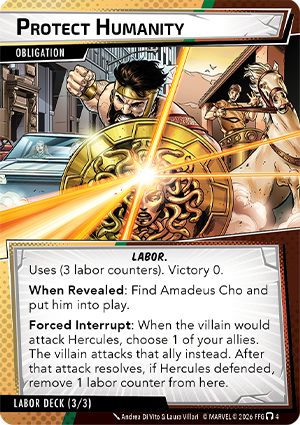
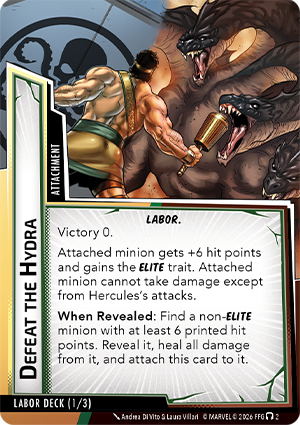
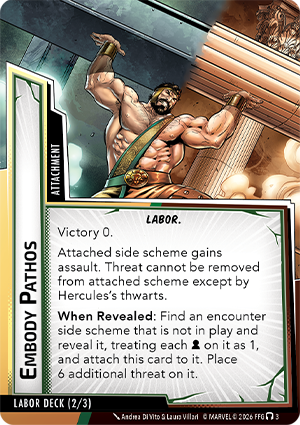
Hercules undertook his legendary twelve labors as penance for slaying his wife and children, a tragedy born of madness inflicted by his jealous stepmother Hera. Upon completing them, he earned immortality. The game asks of you to perform 3 of these labors, albeit adapted to fit the mechanics:
Embody Pathos references the 3 Greek foundations of rhetorics.
- emotion (pathos),
- authority (ethos), and
- logic (logos).
Hercules is overwhelmingly a creature of emotion, the logos tends to fall to Amadeus Cho, and ethos to Athena.
Protect Humanity captures Hercules’s driving priority throughout Greg Pak’s run, particularly during the Skrull invasion when Earth itself hung in the balance.
The illustration for Defeat the hydra is giving a nod to the Hydra organization which I find hilarious.
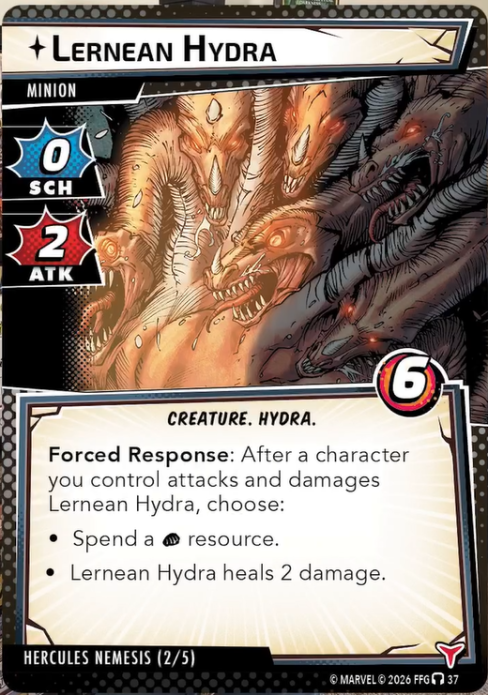
The Learnean Hydra itself is a difficult nut to crack; if we don’t cauterize with fire the wounds we inflict to it, 2 heads grow from the gash!
All those labors can interact with the current scenario, it being the hydra, the pathos, or protecting humanity. Classical sources disagree on the order of the labors, and the comics have fun with this: Hercules and his companions have notoriously sloppy memories, unable to recall exactly when he did what. The game echoes this joke by having us draw labors randomly, which also enriches replayability.
The Gifts
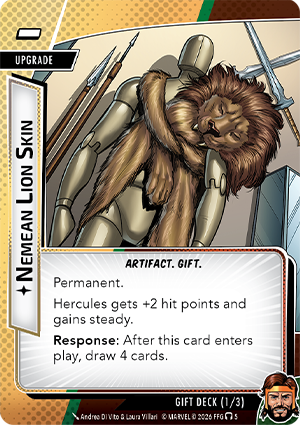
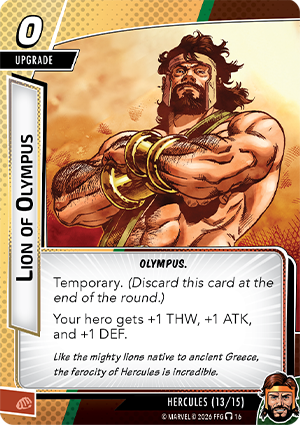
The Nemean lion pictured as a fur was obtained through one of Hercule’s labor. The pelt is impervious to normal attacks, hence gaining steady. Hercules gained the nickname of the Lion of Olympus after defeating the beast.
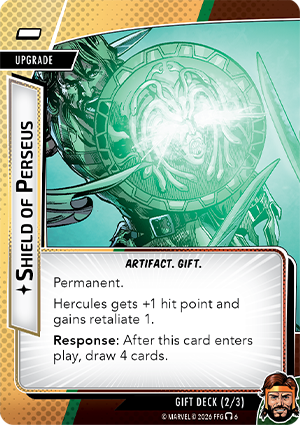
The Shield of Perseus was used to petrify the Medusa. Medusa was capable through her gaze to turn beings into stone. Perseus polished his shield like a mirror, and petrified the Medusa. Hercules inherited this adamantine shield, and gives retaliate as one would expect.
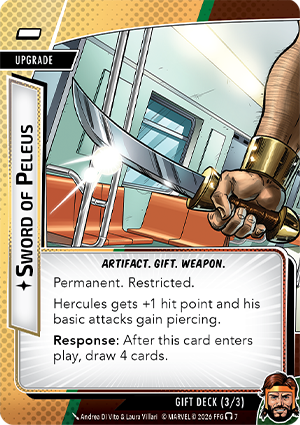
Finally, the Sword of Peleus belonged to the eponymous Achille’s dad. Peleus, Achilles and Herakles were Argonauts together during the Illiad (thanks Migloo and Raxle for this info!). Capable of cutting through everything, it gains piercing.
Amadeus Cho
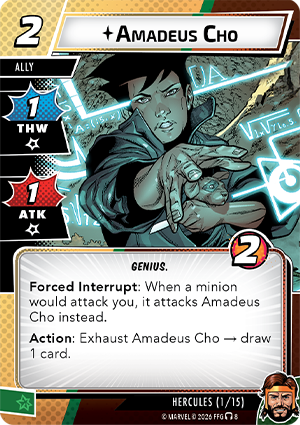
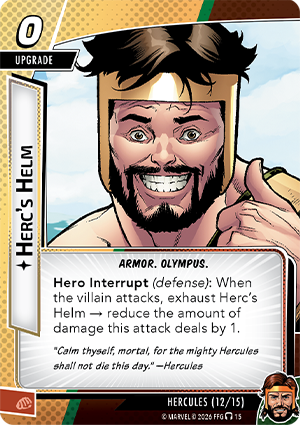
Amadeus Cho is Hercules’s quintessential sidekick: the seventh-smartest person on Earth, insufferably cocky, and perpetually in mortal danger whenever he tags along with the reckless demigod. He’s a polarizing presence, blunt to the point of annoyance, yet invariably right. The tactical edge he provides the Olympians makes him an obvious target. Enemies always come for him first. The game captures this perfectly through his Forced Response, which mirrors exactly how threats unfold in the comics. As usual for resourceful support characters, Amadeus provides card draw, the ultimate resource in Marvel Champions. His surname is Korean, but his first name is supposed to be a nod to Mozart, and I like to think a name meaning “beloved by the gods” proves remarkably fitting for someone who becomes an Olympian’s closest companion. Players may recognize him: he already appears in our game as Brawn, though his transformation into that muscular dude form comes later in his story. Cho is the center of a vertical cycle with Herc’s Helm.

A cycle is a series of cards that echoes each other. The cycle can be “horizontal” with one card in each aspect, or “vertical” if they are in the same set. Professor X and Cerebro is a good example of a vertical cycle. Tac team, command team, interrogation team and med team is an example of a horizontal cycle.
We have plenty of cycles in Marvel Champions, in fact, the whole first 2 cycles are only horizontal cycles.
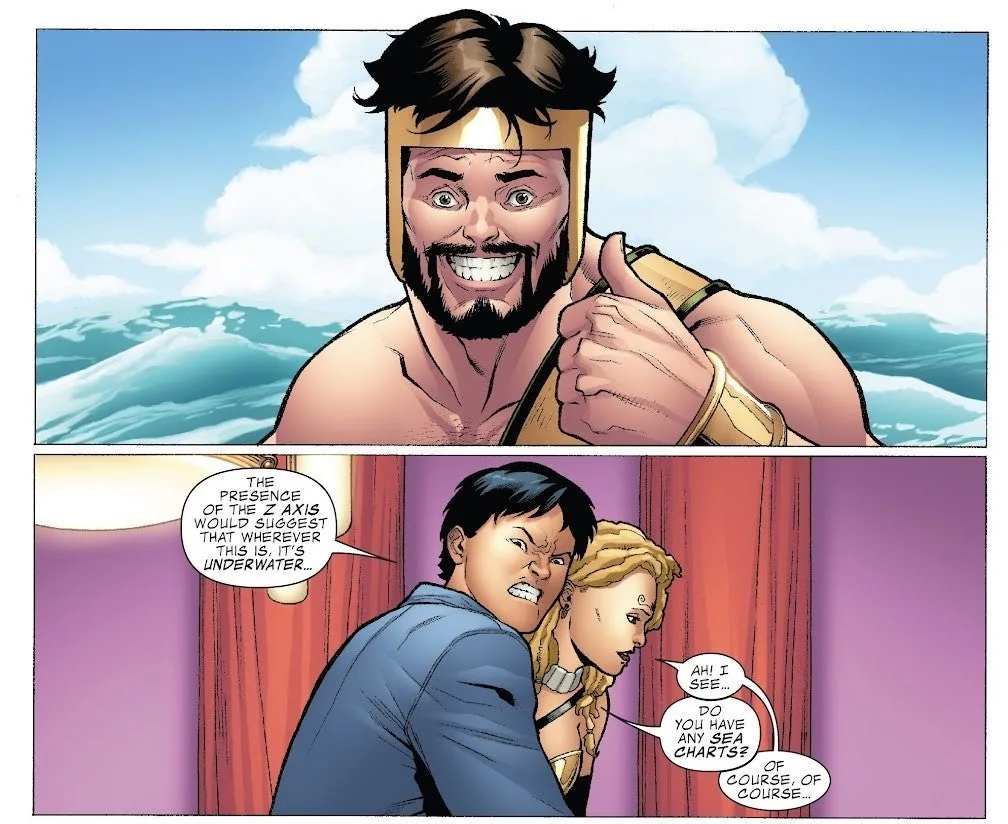
Herc’s Helm is a famous meme. During the “Love and War” story, Amadeus gets seduced by the head of the Amazons. Just when he is about to do it, the Amazon uses her charm to extract some key intel from Amadeus. As he is spilling the beans, he peeks through the window and sees Hercules a few feet away from the nuptial room, with this hilarious face saying: “go buddy, I got your back”, which must be a pretty strong turnoff. It happens it was a honeytrap, and Hercules ends up saving Cho. Our cards retell the story perfectly, as the Helm allows Hercules to defend Cho in a bind with the defense keyword. Good job Frank, this is a stellar job!
Wisdom of Athena
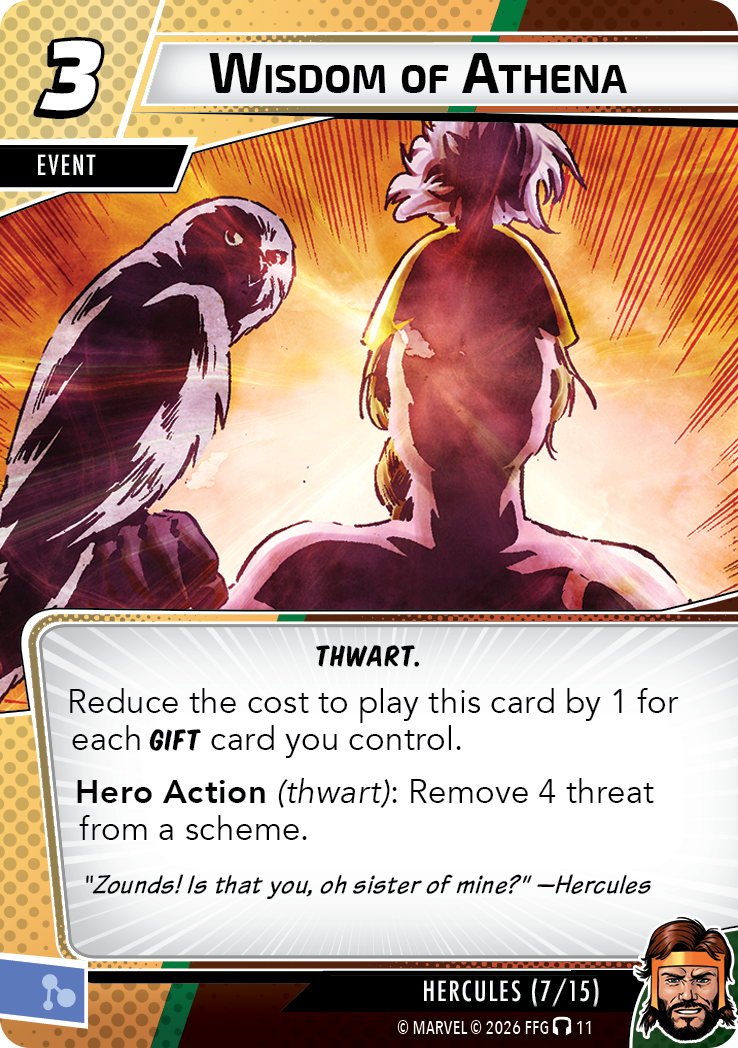
Athena, Hercules’s half-sister, is another central figure in his story. As goddess of wisdom, justice, and countless other domains, she watches over humanity and its champion. She serves as Hercules’s guide, reaching him through telepathic whispers, prophetic visions, and divine nudges. Think of her as the Olympian equivalent of Xavier or Nick Fury: the strategist in the background, steering the hero toward where he’s needed most. The illustration embodies this, but I would have preferred another one.
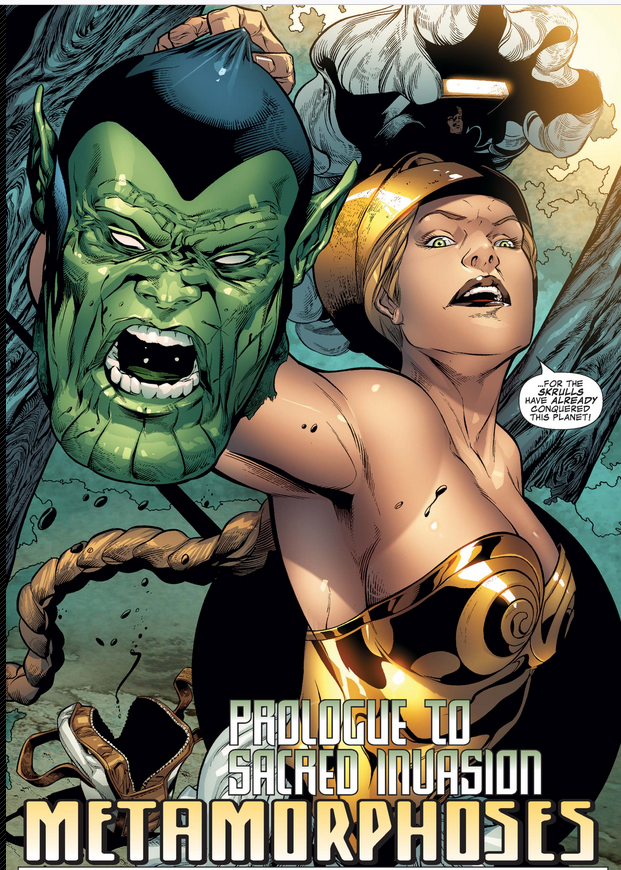
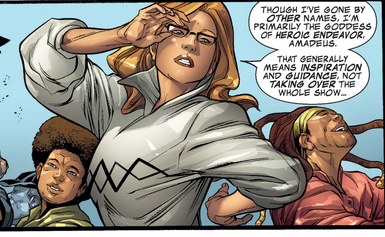
The Gift of Battle
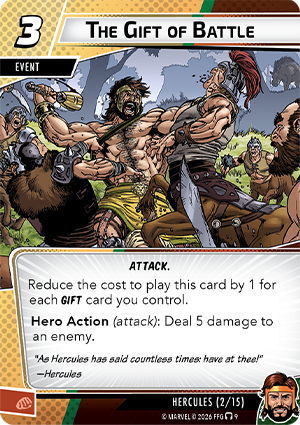
The gift of battle is an expression used by Hercules each time a brawl is started. Apparently, it’s a gift to be able to fight when you are immortal.
Olympus
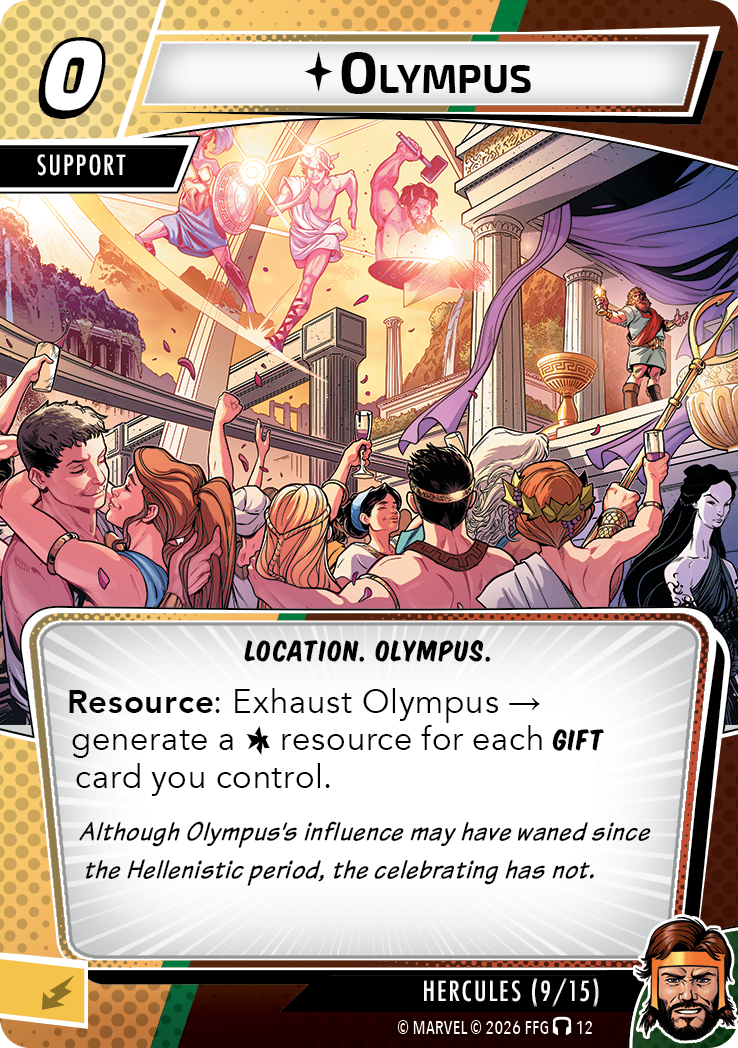
In Marvel, Olympus exists as a pocket dimension tethered to Earth—an eternal celebration where the wine never stops flowing. Hercules has gone overboard there more than once. True to form, the game reminds us that home bases are resourceful places.
The brothers
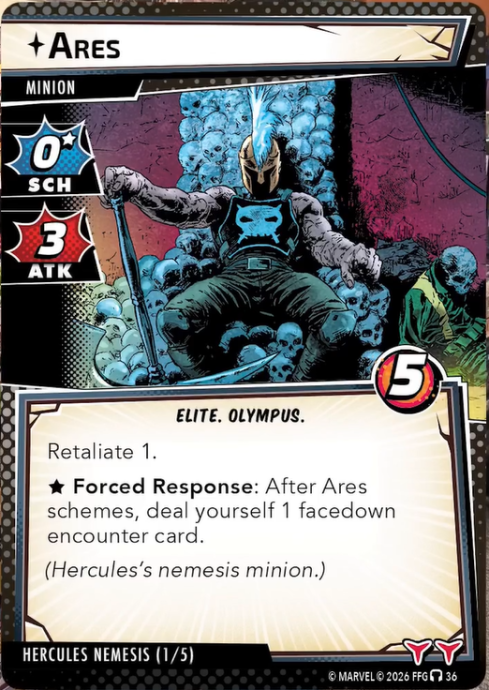
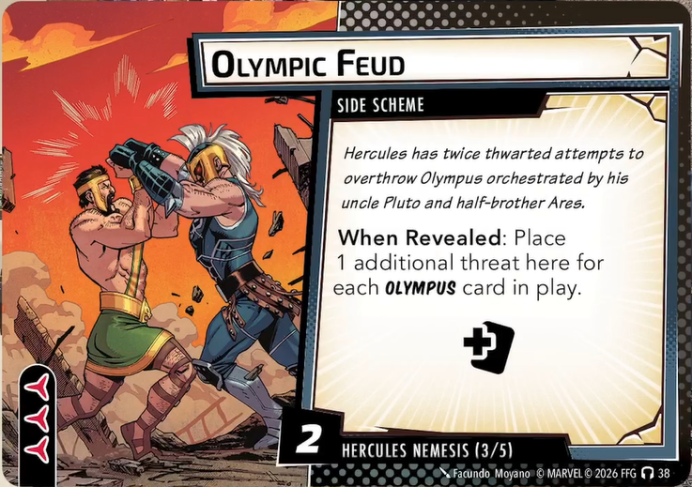
In Greg’s Pak run, Ares fights constantly with his half brother Hercules. Ares is a typical grudge-holding brother, always retaliating when attacked. He brings trouble to the table, having his own agenda with his scheming power and not contributing to the main villain’s scheme. The way I read Ares’ side scheme, the closer to home the bloodier it gets, Ares trying to usurp the richness of Olympus.
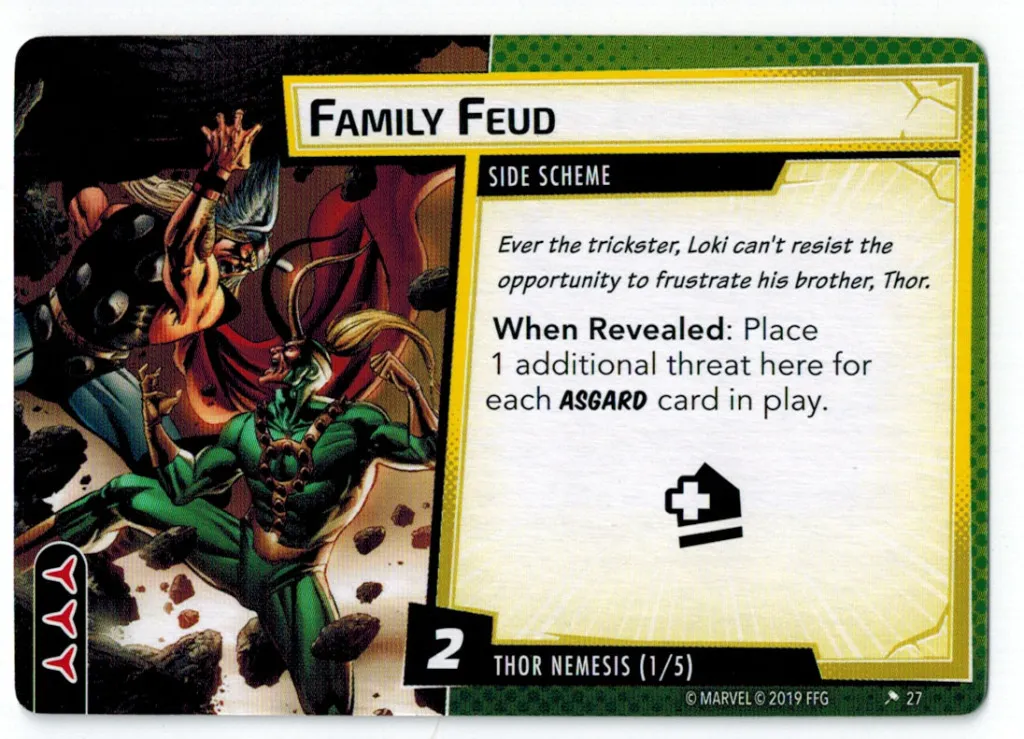
This is not the first time brothers are fighting our game and the designer echoed the original implementation.
All versus All
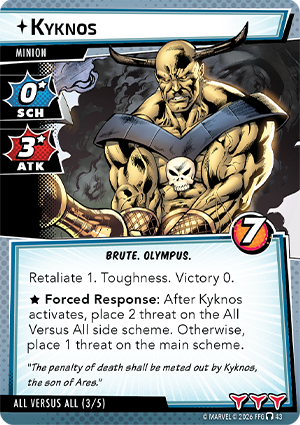
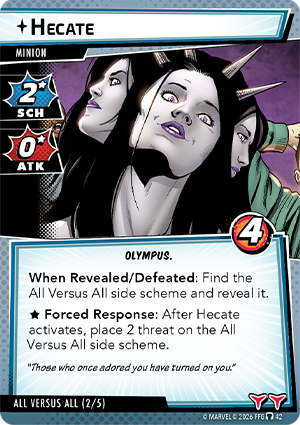
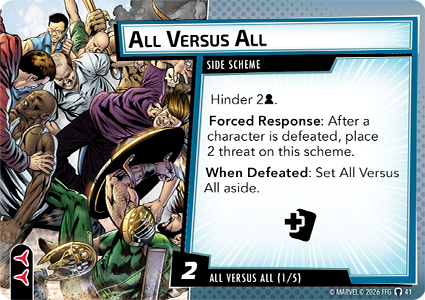
Kyknos, Ares’s bloodthirsty son, and Hecate, witch goddess of magic and crossroads, team up during Fear Itself to seize Brooklyn and transform it into a nightmare landscape. Hercules killed Kyknos long ago, sparking Ares’s eternal grudge—but death rarely sticks for Olympians. Both cards pile threat onto a side scheme, capturing the chaos of an all-out divine brawl. It also gives another target for the Hydra labor, so that’s very a propos.
Namora
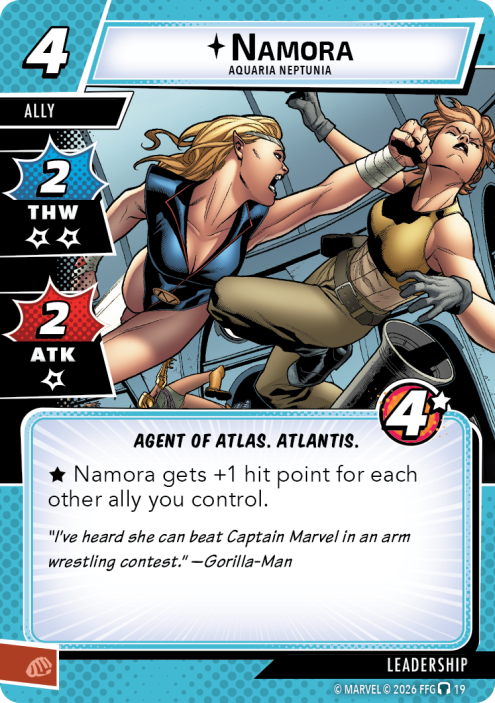
Namora is Namor’s cousin, sharing his Atlantean heritage. She’s been around nearly as long as he has, practically since the dawn of Marvel. Incredible Hercules revitalized her character, making her inclusion here a natural fit. She and Hercules are lovers and partners in adventure. A true team player, she grows stronger with allies at her side. She’s also a member of the Agents of Atlas, a team composed entirely of Asian heroes like Cho and Aero. The trait makes its second recent appearance here, and the team was also written by Pak, who seems to be a designer’s favorite. Could this be a hint of things to come?
Thor
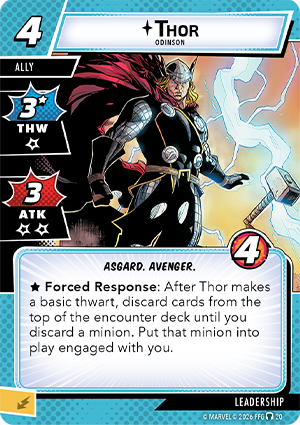
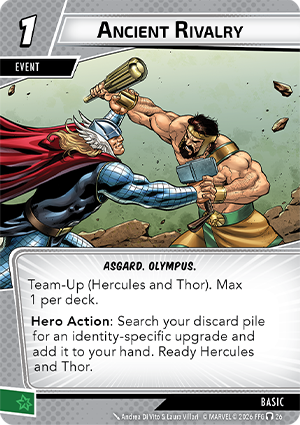
The Marvel Universe hosts several pantheons of gods — Olympians, Asgardians, the deities of Atlantis are already present in our game.
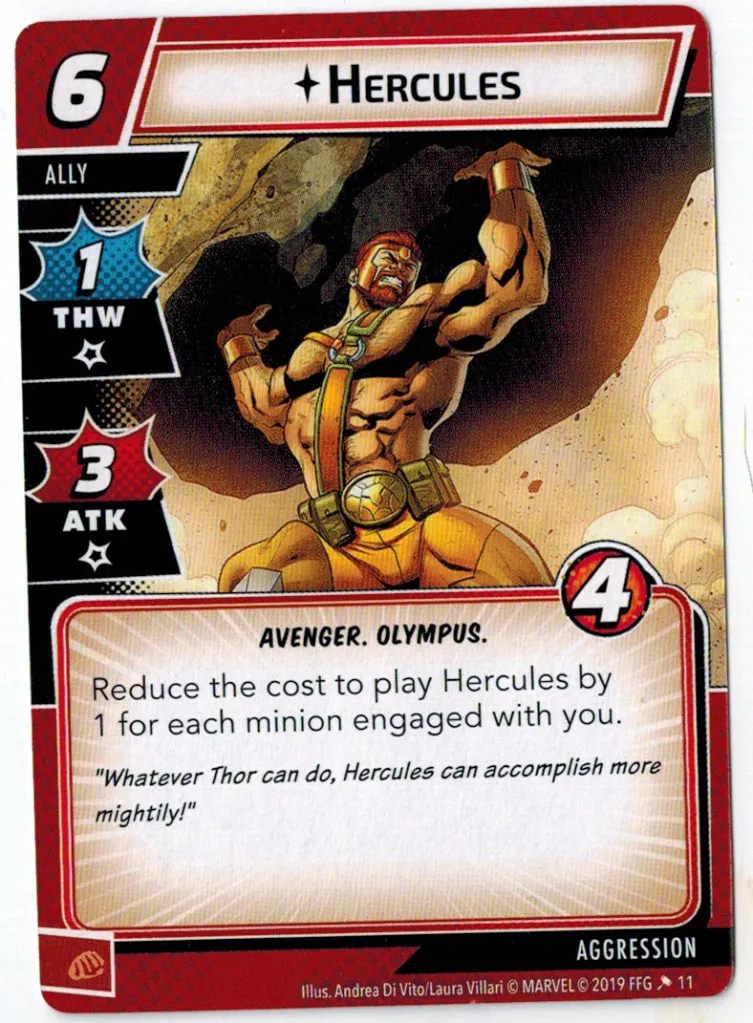
If I had a cent for every time Hercules and Thor came to blows, I could have bought my entire pack. From a game design perspective, it’s excellent, multiple hooks whether you want to exploit his stats with Teamwork or use him as a minion magnet. It echoes his hero’s concept. I like that the custom illustration tried to copy Thor’s image style. The rivalry or should I say competition between them allows to get a weapon, mace against hammer, and get ready to boast, huh, ready to fight.
This card echoes the presence of Hercules in Thor’s preconstructed deck too, showing that thematic ties between heroes and allies have been here forever.
Naturally, we’re left wanting more.
Deathcry
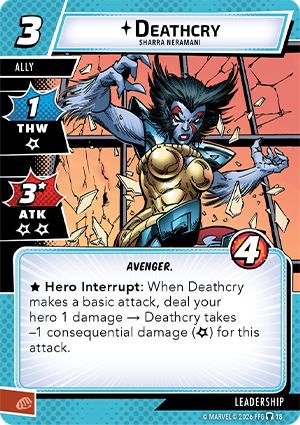
Deathcry is a Shi’ar bird-woman and one of Hercules’s companions. She’s a berserker at heart, so I believe her ability represents her going absolutely feral. I confess I didn’t know prior to writing this article.
Gilgamesh
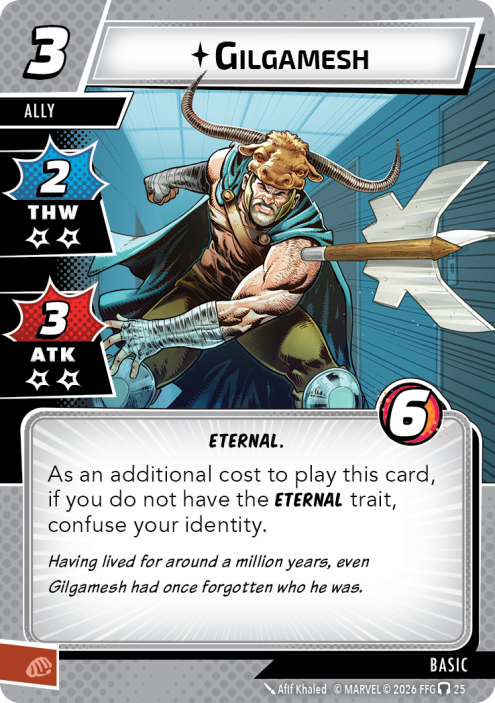
Gilgamesh goes through a rough patch and crashes on Hercules’s couch while getting his life together. He’s both a god and an Eternal. His presence can be overwhelming, like standing before an elder deity. Hercules can become steady and circumvent this inconvenience.
Avenge me!
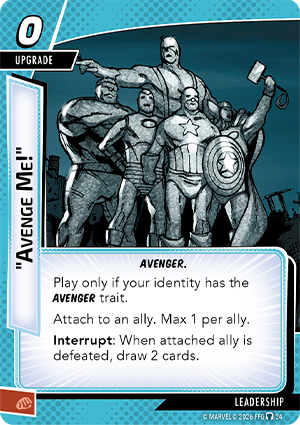
The Avengers statue pictured in the art inspired the Young Avengers: Wiccan, Patriot, Speed, Iron Lad, Hawkeye (Kate Bishop) and Hulkling. This wave gave us all the remaining missing members and the team is now complete. Sadly, the team got develop as a “horizontal cycle”, one in each aspect that is. The brothers Wiccan and Justice are in Justice, Patriot is in Protection, Kate is in Leadership, Iron Lad is in Basic and Hulkling is only a hero. When the Avengers disbanded, it gave these kids the nudge they needed to step up and become a real team.
My 2 cts
This pack is a celebration of what narrative design can do. From the alternative victory condition with the very difficult labors, to the vertical cycle around Amadeus, its design is a treasure trove of nuances and innovations. I loved Frank’s first foray as a designer in Marvel, it is ambitious and as any first timew, it will be polarizing among the conservative players, but I think after 60+ heroes, we can afford to have a couple that are radically different. Jump in if you are interested in narrative design and challenging deck building.
Reading List
Hercules has been around for a long time, but the FFG version is clearly designed after Greg Pak’s run. The Incredible Hercules is truly a hidden gem, hilarious, high pace, fun action. One of the easiest recommendations I have given on this blog, go read it. Note that you have to read the Incredible Hulk #112 to fully understand the Incredible Hercules #113-115. The old Hercules from Layton are also whimsical easy reading book I recommend. As usual, I also recommend to read the main issues of the Civil War where Hercules play a minor role.
I would love to chitchat with Frank about his design process, he has been relatively absent from interviews.