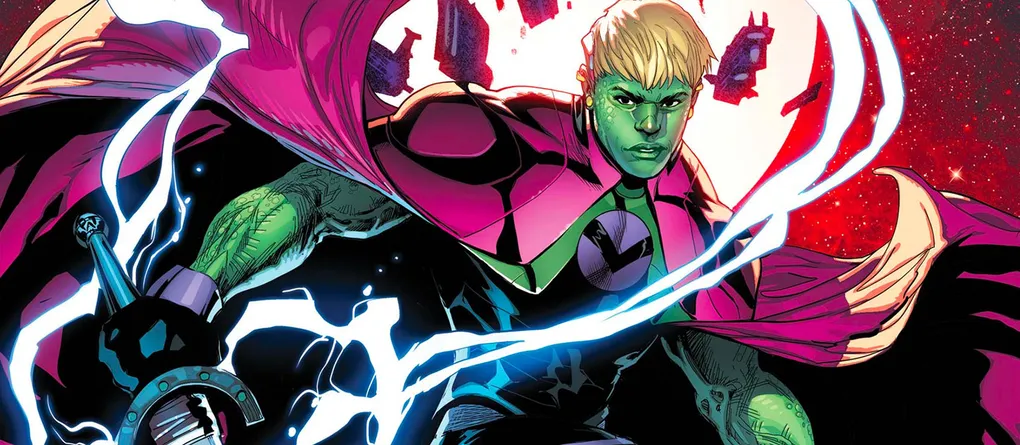
Hulkling
Hulkling isn’t exactly a household name outside of comics—he’s never appeared in the MCU or any of the major TV shows. That said, he’s currently tearing it up in Marvel Rivals, which is absolutely massive right now, so who knows? He might be on the verge of breaking through to mainstream recognition.
Since the announcement from FFG that Hulkling would be released, I’ve read through everything featuring him since his debut in 2005, and I was genuinely surprised by how many stories give him a significant role. His themes feel ably modern, and I’ll do my best to do them justice. This time around, our cards will capture most facets of his life.
So buckle up, shapeshift into something comfortable, and let’s dive in!
Complicated lineage
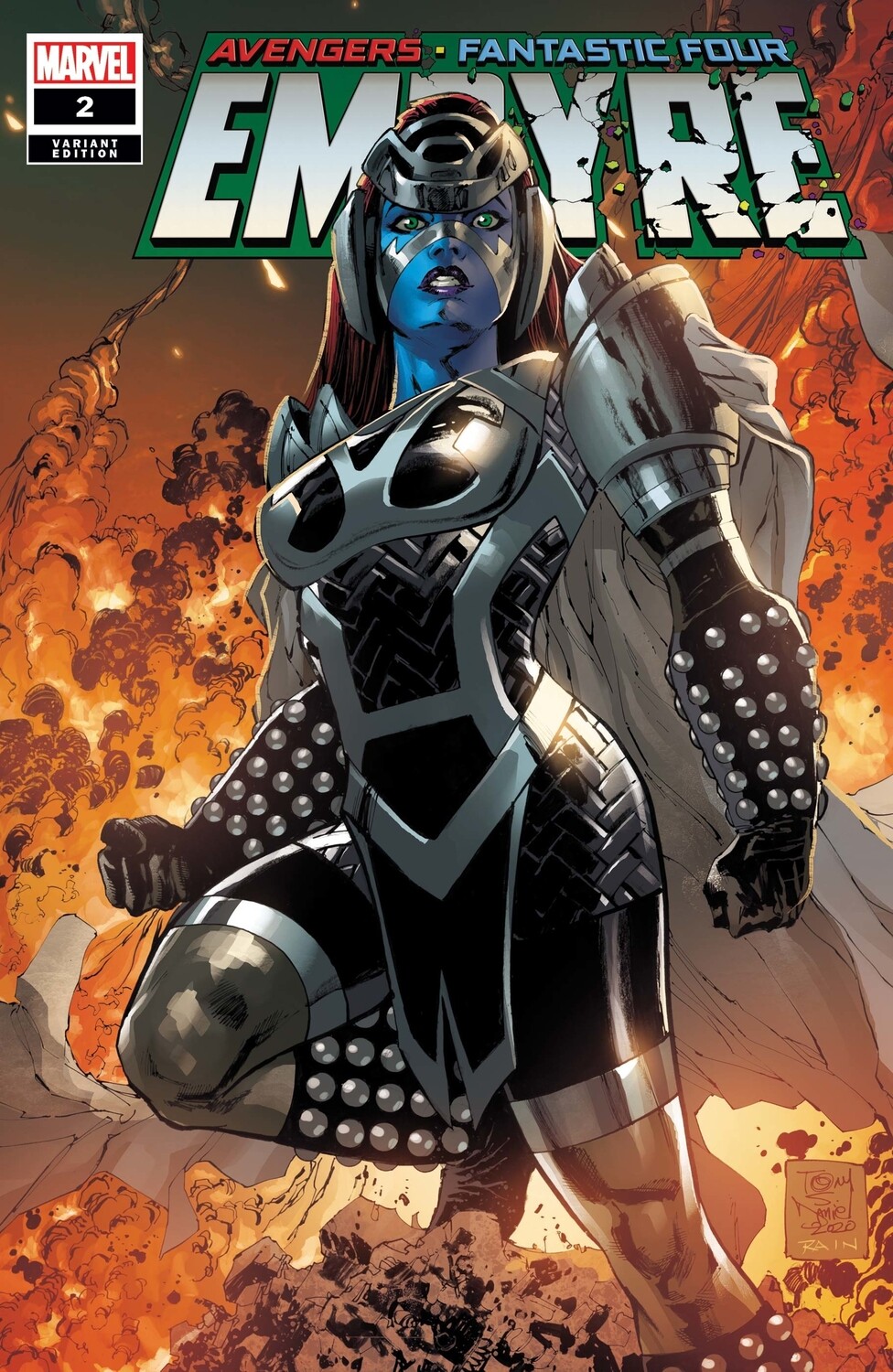
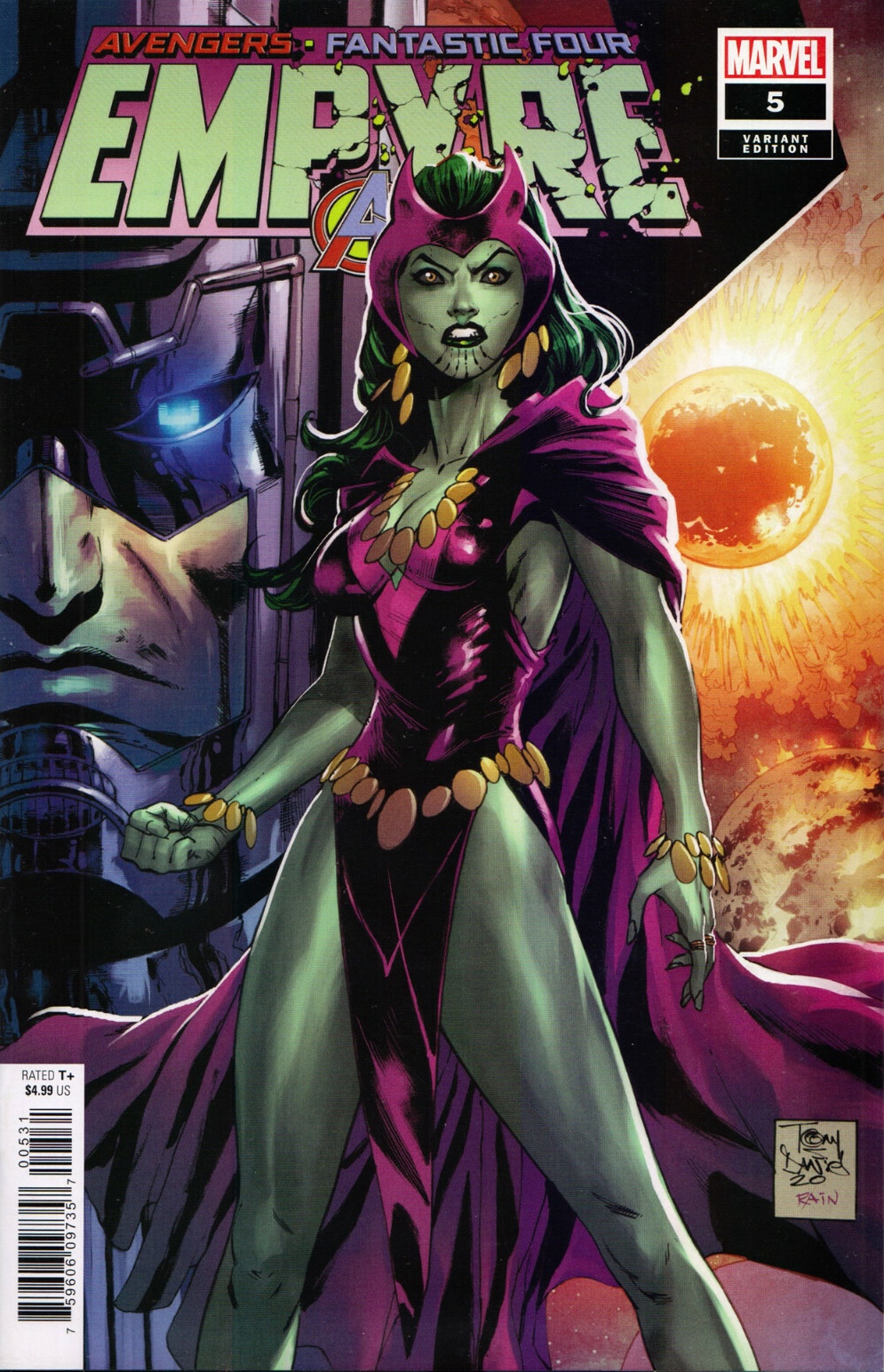
Far out in space, a long time ago, two empires were rising.
On one side, the Kree: a belligerent species of blue-skinned humanoids. They don’t possess inherent superpowers, but they’ve adapted by incorporating technologies from countless civilizations they’ve encountered—or conquered—across the galaxy.
On the other side, the Skrulls: a green-skinned people who built a sprawling merchant empire on the back of one extraordinary gift—shapeshifting. Within seconds, a Skrull can assume anyone’s appearance right down to the DNA. It’s perfect for espionage, for blending in, for trade negotiations… and for combat, since they can morph their limbs into claws, blades, or any organic weapon imaginable.
These two empires once had a promising relationship. But jealousy, narcissism, and betrayal twisted it into something uglier, until diplomacy collapsed entirely into all-out war. The Kree and Skrulls have been killing each other since 1972—in our comics, at least. They were conceived in part as an allegory for the Israeli-Palestinian conflict, and modern retellings continue to lean into that parallel.
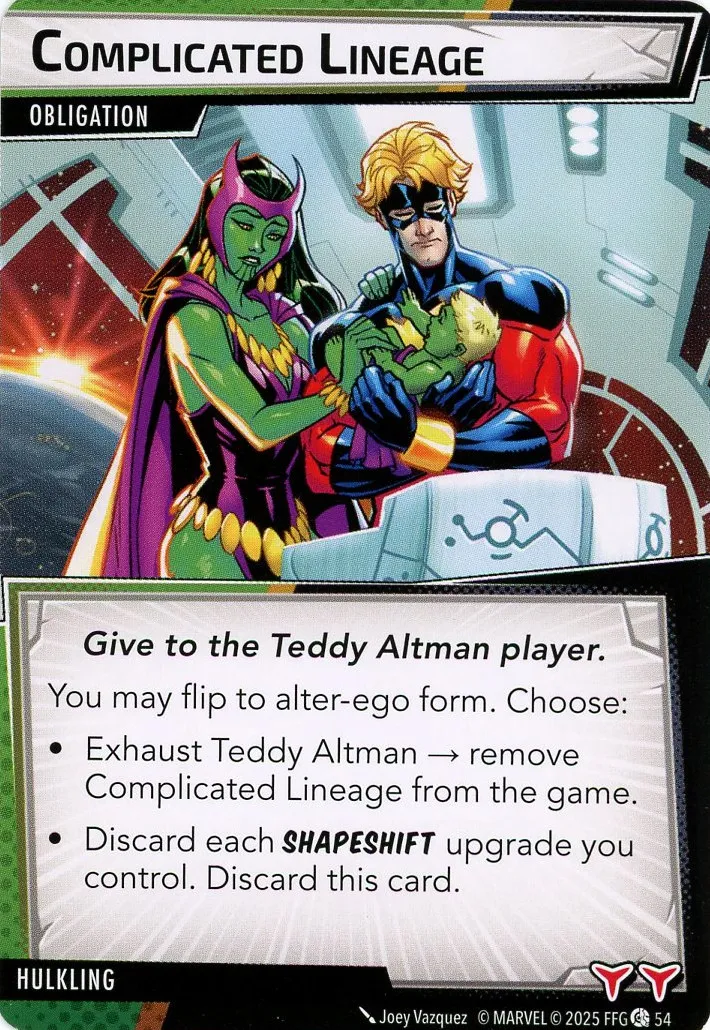
Captain Marvel—the blonde man pictured on this card—was heir to the Kree throne when he was abducted by the Super-Skrull, a ferocious warrior fiercely loyal to the Skrull Emperor. But captivity took an unexpected turn: the Skrull princess Anelle fell in love with Marvel, and together they conceived a child—Hulkling.
The Emperor refused to accept this half-breed lineage. He ordered the “Culling”: the massacre of all Skrull newborns to kidill his grandchild.
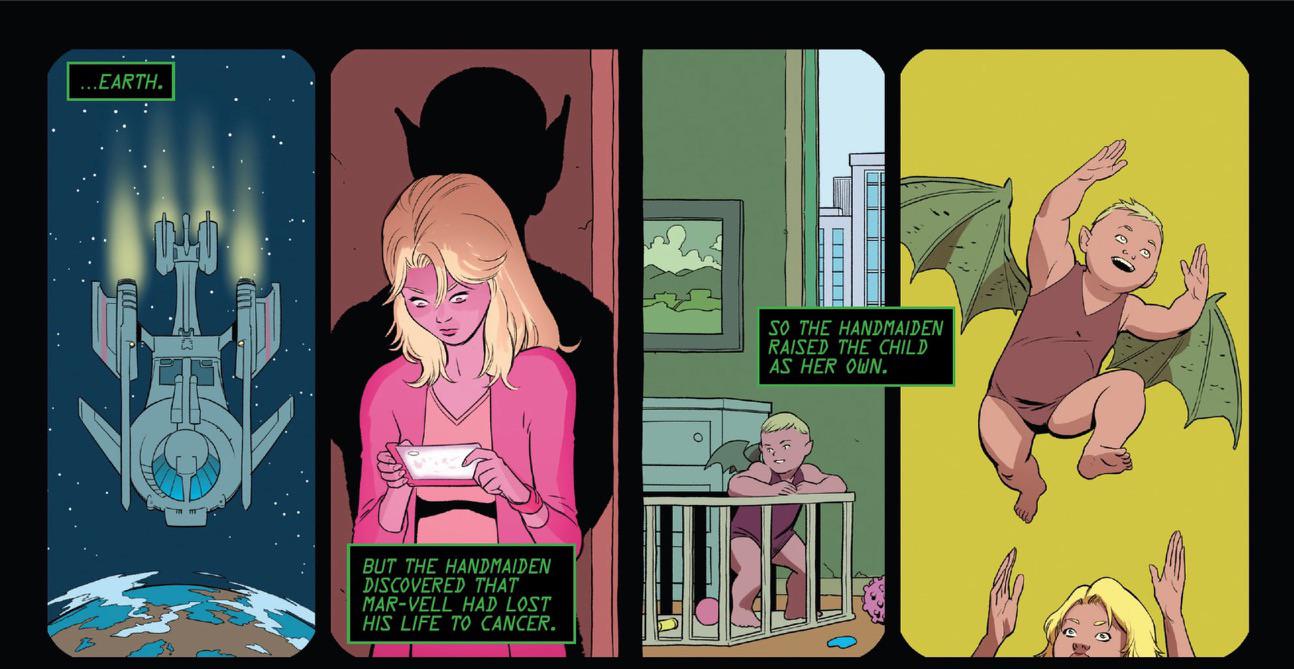
Terrified for their son’s life, the parents sent their baby to a backwater planet called Earth, hidden among humans.
Teddy Altman
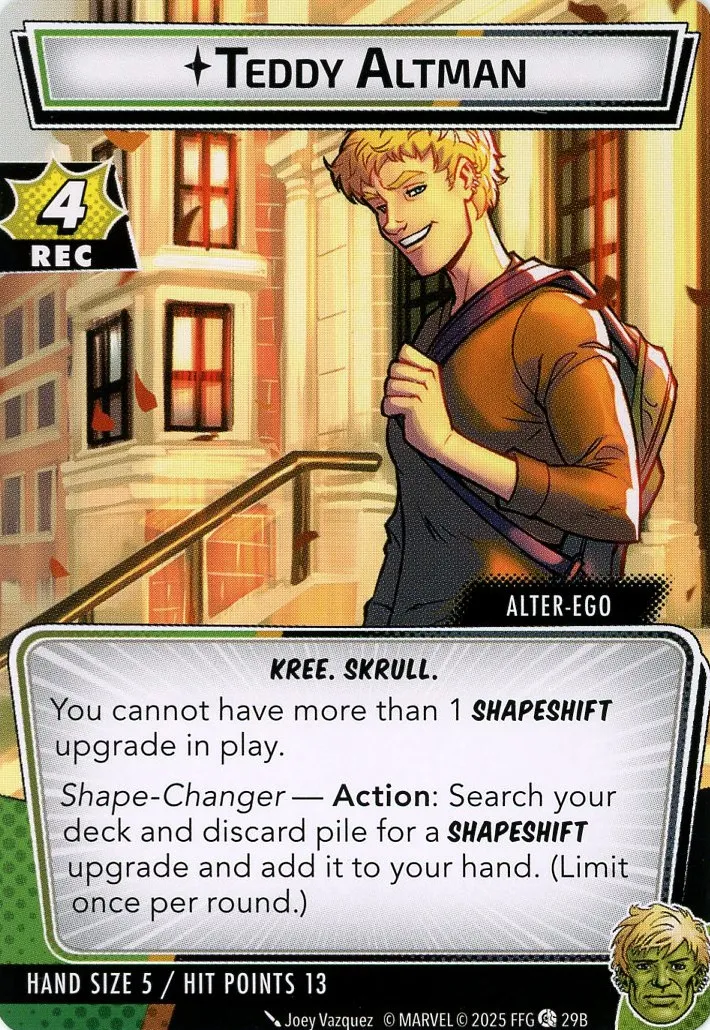
Here we see Theodore as a young teenager—exactly how we first met him in Young Avengers. The streets of his home city, New York, stretch out behind him.
At this point, Teddy has no idea about his Kree and Skrull lineage. As far as he knows, he’s just a regular human kid. But he’s inherited his mother’s shapeshifting abilities.
Teddy is like vanilla ice cream: everyone loves him. He’s refreshing, candid, and admittedly a bit of a stereotypical wannabe hero. I’ll confess—I’m usually drawn to more layered, nuanced characters, but Teddy is an exception. He has this gift for always finding the right words, and there’s something genuinely inspirational about reading a character who shows you how to be a better person.
Hulkling
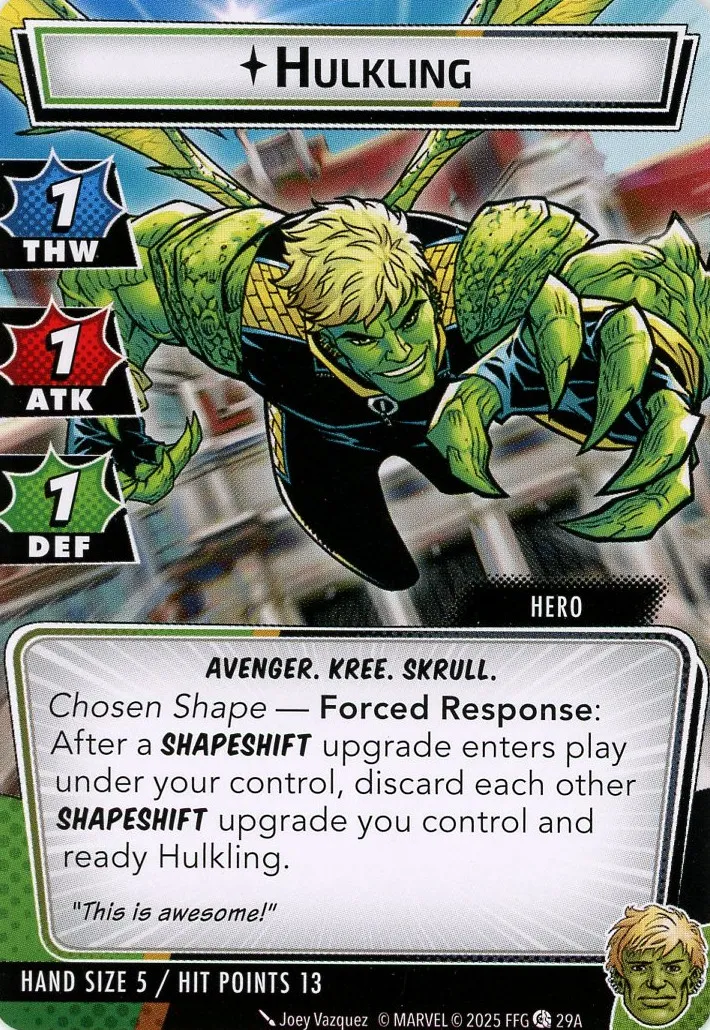
In the early 2000s, the Avengers disbanded—much to the sorrow of their younger fans. The world felt like it was falling apart, and some kids, Teddy among them, started gathering around Avengers Mansion. Long story short, the ones with powers decided to form the Young Avengers: a scrappy pastiche of Earth’s Mightiest Heroes.
Teddy’s teammates nicknamed him “Hulkling” because he’s green and buff—like the Hulk. But there’s no gamma radiation involved; it’s all shapeshifting. The designers chose to model Young Avengers and Avengers with a single trait, which makes sense to me—by the 2010s, both teams had merged anyway.
His unusual stat line of 1/1/1 with 13 hit points hints at a playstyle distinct from standard humans. And the flavor text perfectly captures his candid, enthusiastic nature.
Alien Physiology
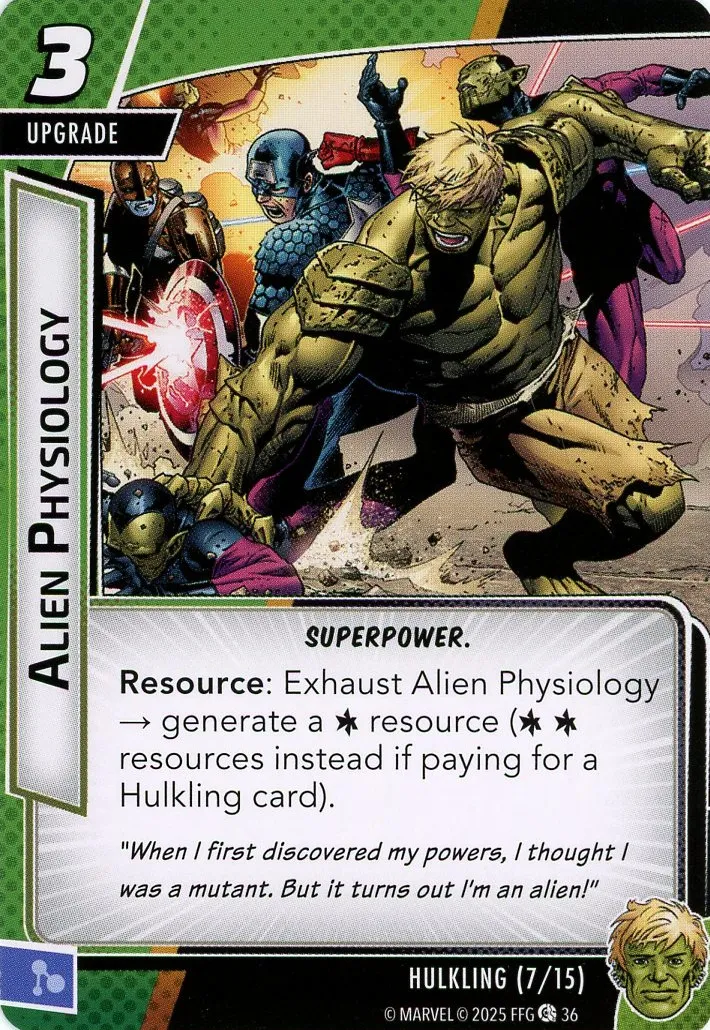
As Boomguy noted, this card stands apart from other resource generators. Building around it feels odd—almost alien—since it heavily favors cards costing 2 or more, while the rest of Teddy’s kit leans toward 0-cost events. In practice, it mostly helps finance his own signature cards.
The flavor text tells a touching story: Teddy’s adoptive mother made him believe he was a mutant, like the X-Men, rather than a Skrull. It was a lie meant to protect him from the wrath of his grandfather—Princess Anelle’s father, the Emperor who ordered the Culling.
Wiccan
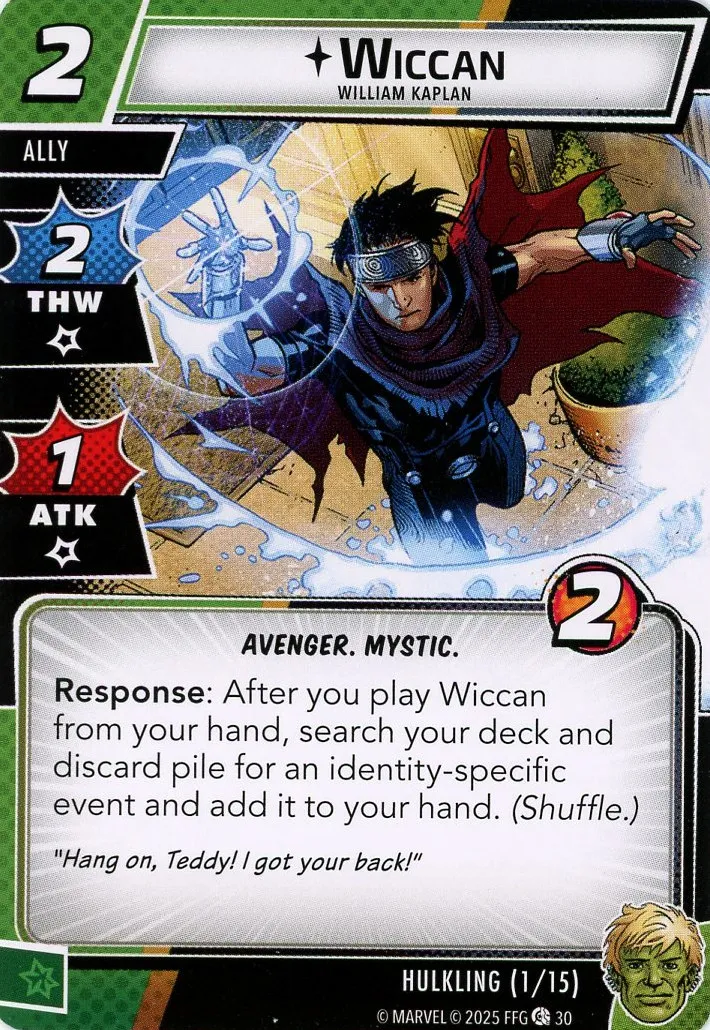
Essential to Teddy’s story is William—Billy—his Jewish childhood friend, lover, husband. His everything.
In Young Avengers, Teddy comes out, and his adoptive mother is delighted—not because he’s gay, but because of who he chose. Wiccan. I felt the same way. What I love about their relationship is that it drops us right into the middle of a true, happy, uncomplicated gay couple, where each makes the other a better version of himself. It’s also with Billy’s support that Teddy learns to embrace his natural green Skrull appearance.
Wiccan’s in-game ability perfectly captures this idea of helping Teddy become his true self. In the comics, Wiccan is the Young Avengers’ pastiche of the Scarlet Witch—who turns out to be his mother—and he inherits the Mystic trait accordingly. To prove the point further, the other Wiccan ally was in the Scarlet Witch hero pack.
Residence
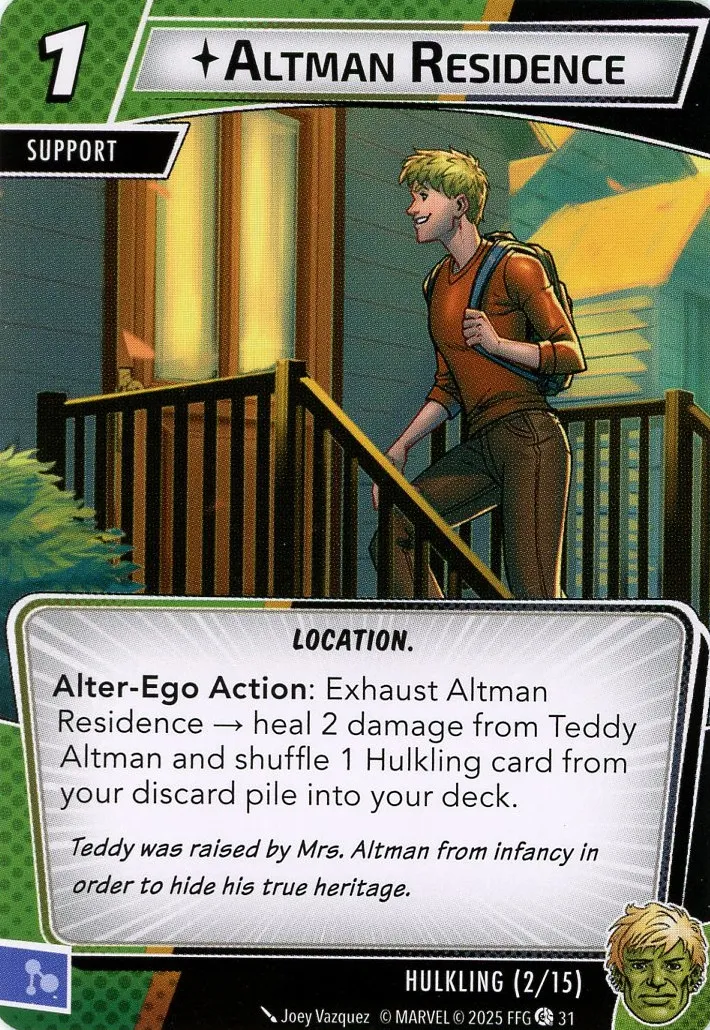
Teddy lived a happy life with his adoptive mother, Mrs. Altman. The choice of this location grounds the story in the Young Avengers and Civil War era. Billy and Teddy got their own place together afterward.
Real-world locations matter in Teddy’s stories. They bring their own folklore with them: the shoebox-sized NYC apartments, the diners, the gay clubs draped in militant rainbow flags. These settings aren’t just backdrops—they’re part of who he is.
The shapeshifting
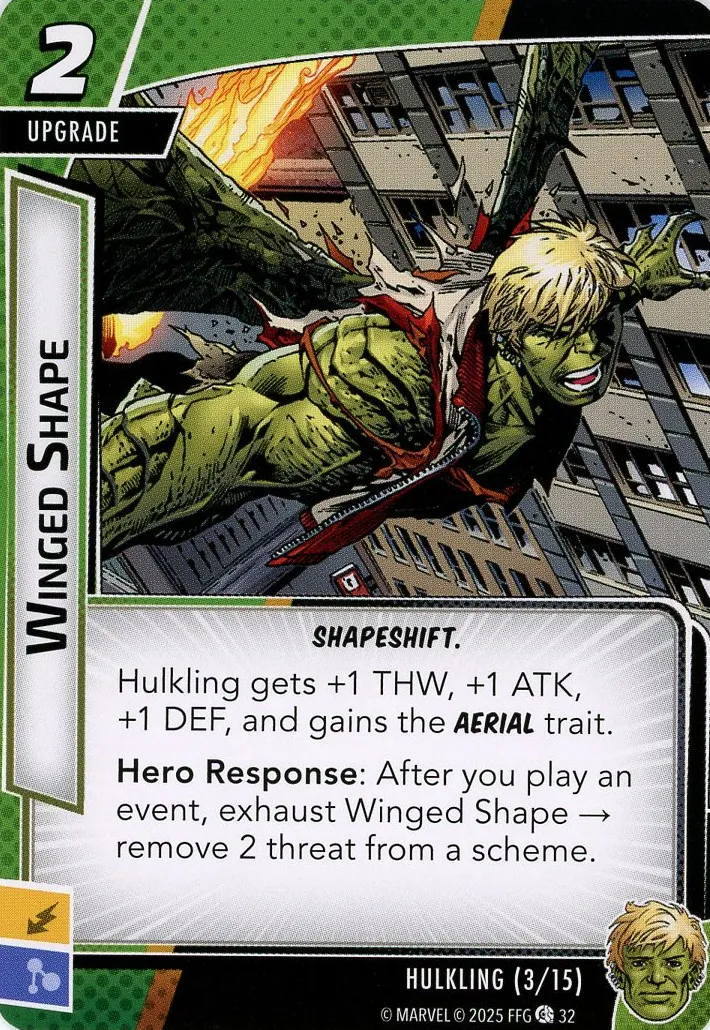
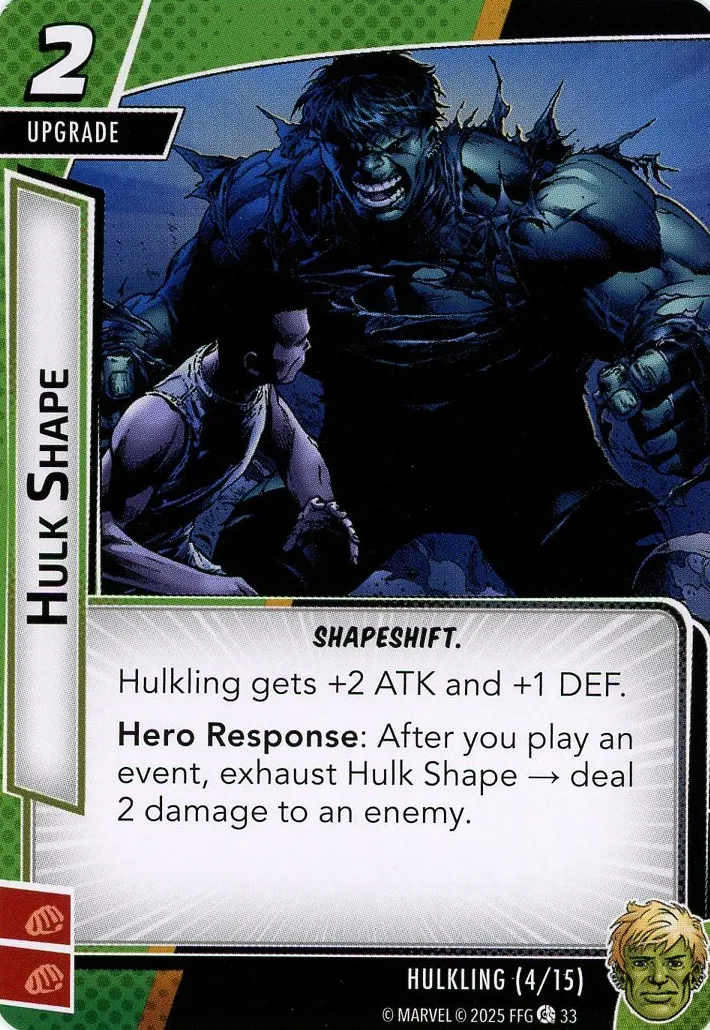
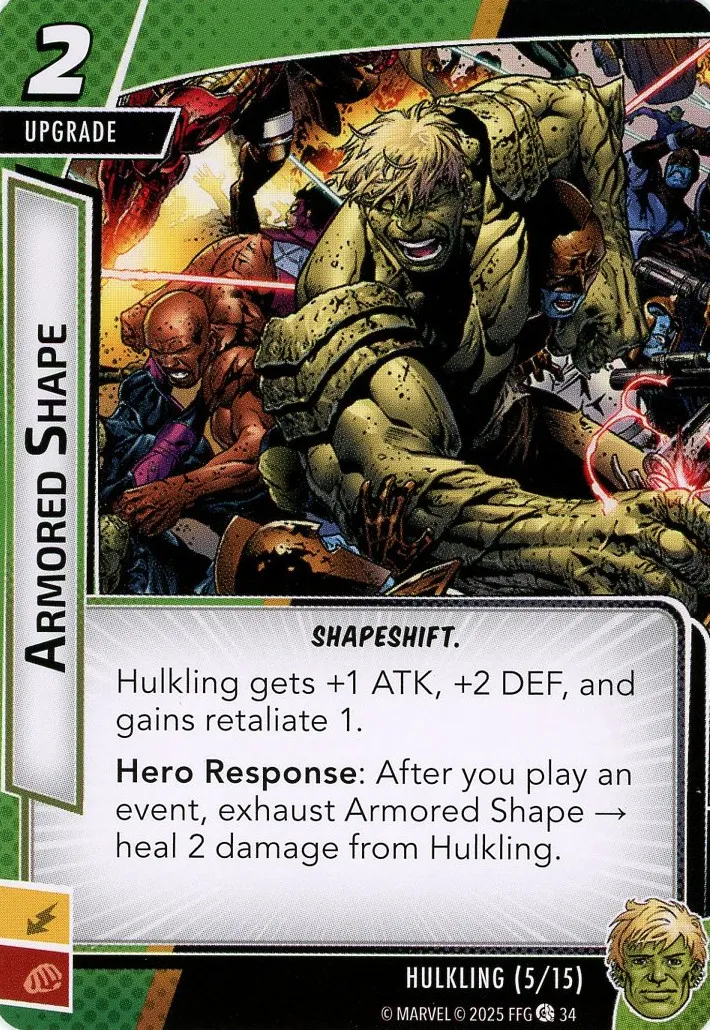
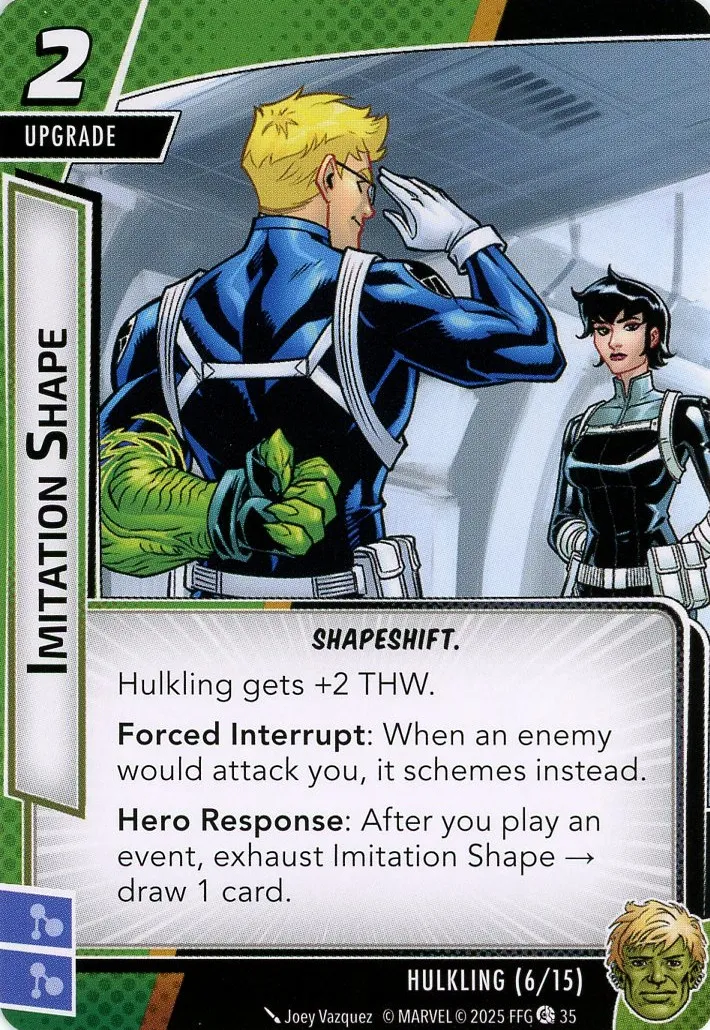
Skrulls can shapeshift in seconds and hold a form for years. They use this ability for everything: fighting, infiltrating, deceiving, even flying. All of these illustrations are pulled directly from the comics—except for Imitation Shape.
The illustration ordered by the designgerws for Imitation Shape feels a bit goofy to me, and doesn’t quite capture the genuine danger that Skrull infiltration represents for both parties.
The double resource symbols are mostly mechanical, to offer a choice between transforming or not. This was a tentative I think to offer the choice to transform, or not, as Skrulls can stay in shape for years.
Impersonation
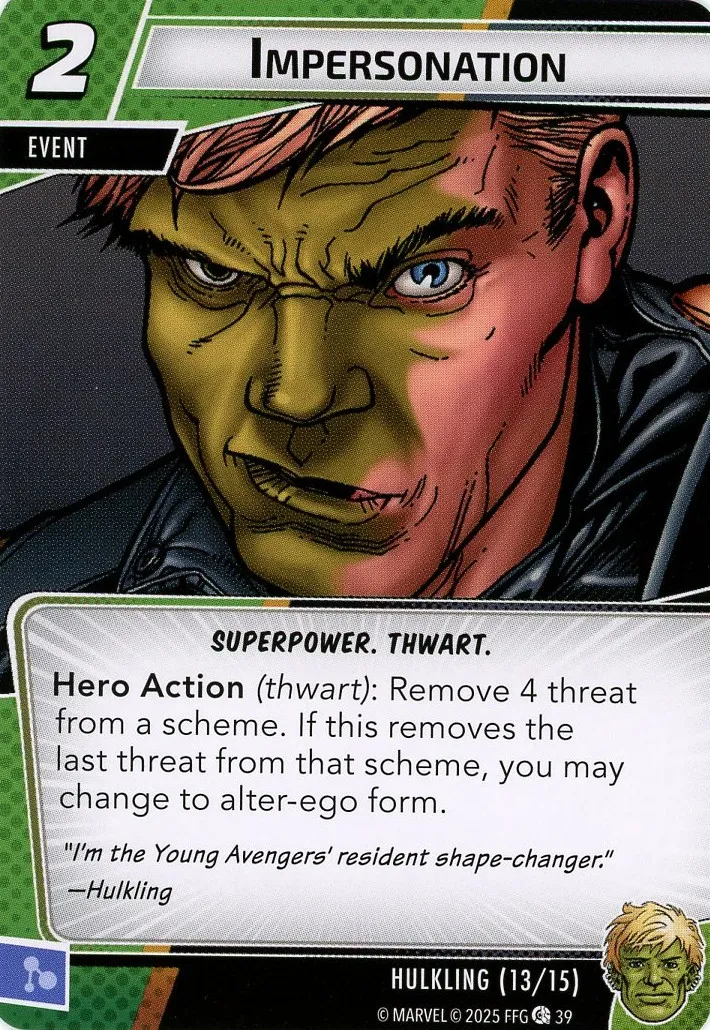
This is Hulkling’s most important scene during Civil War.
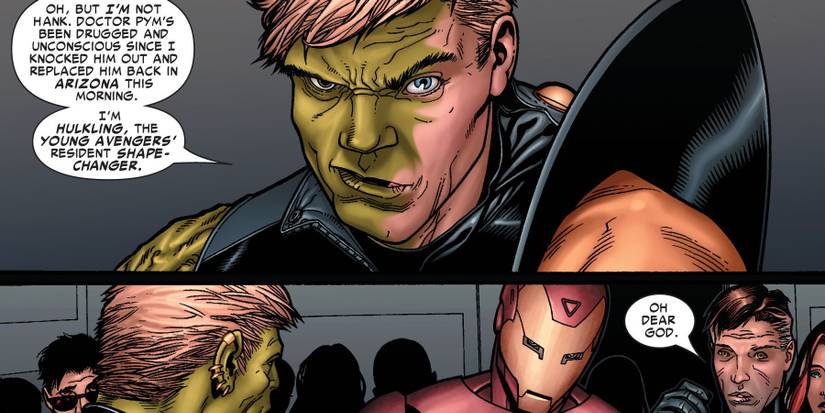
During the Civil War, the Registration Act forces all heroes to reveal their true identities to the authorities. These kinds of discriminatory laws don’t sit well with someone like Teddy: he’s gay, Jewish, half-Skrull (which, as we’ve discussed, carries its own allegorical weight). History has done plenty of wrong by folks like them. Naturally, he joins the resistance.
Using his shapeshifting abilities, Teddy infiltrates the pro-registration administration disguised as Hank Pym—an ally included in this box. The intel he gathers proves essential for the final standoff. Like Tigra, then, Hulkling operates on both sides of the conflict. This allows us to play scenarios from either perspective without thematic dissonance.
The Super Skrull
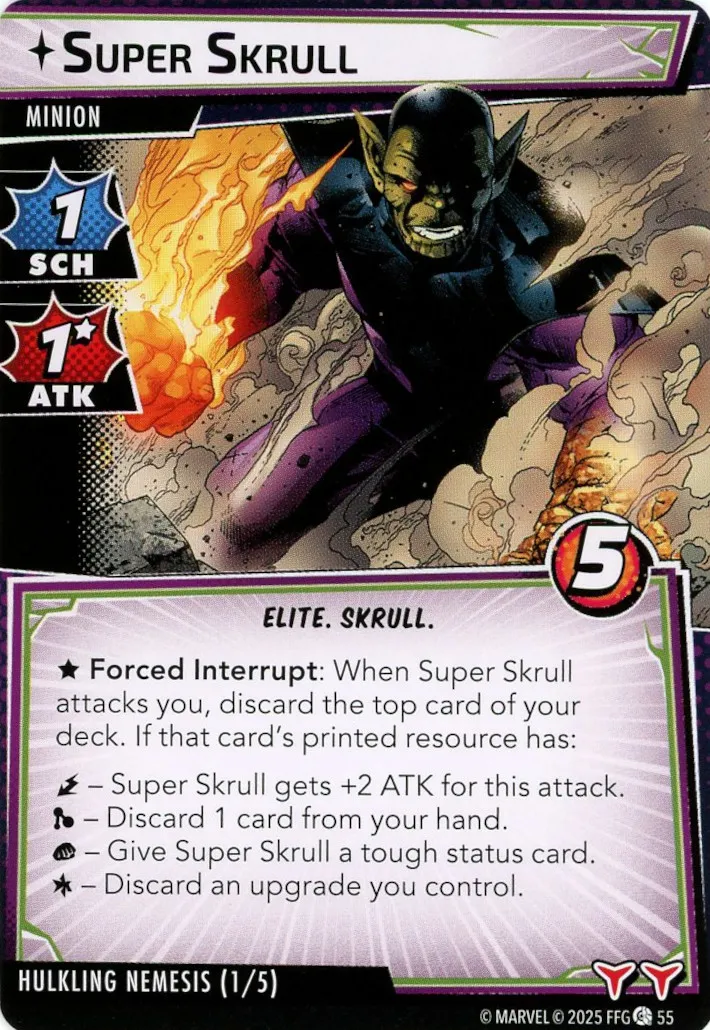
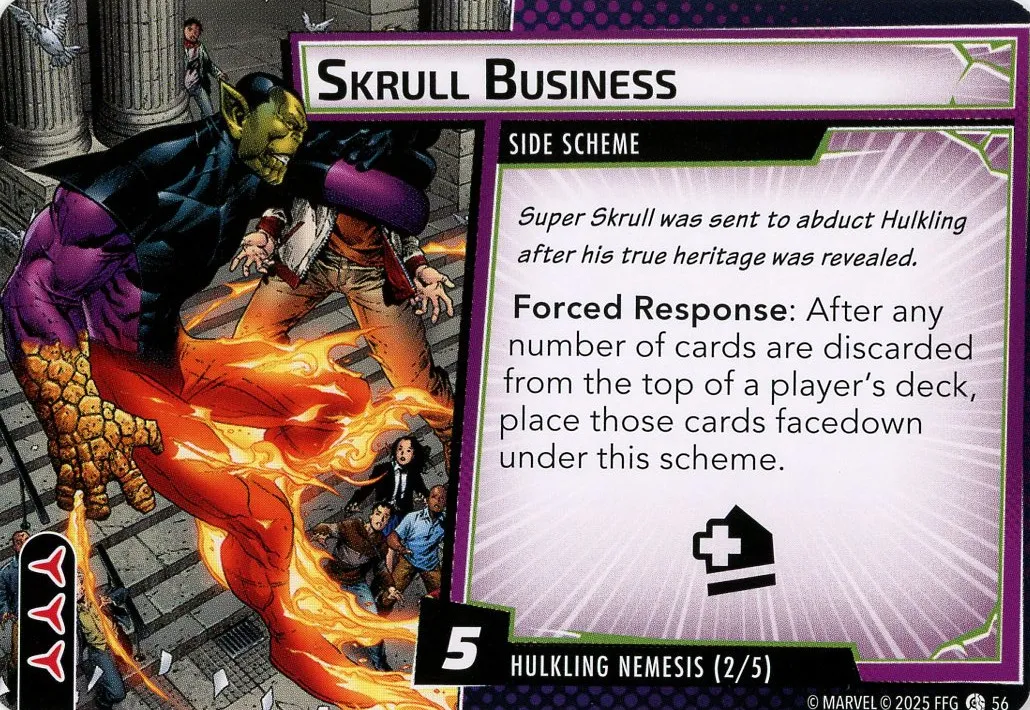
Like any suspicious middle-aged man with a white van, the Super-Skrull has a habit of abducting everyone in sight. Captain Marvel, Teddy—twice…
I love the illustration on this side scheme: the Nemesis is shown wielding all four Fantastic Four powers simultaneously while kidnapping Teddy to drag him back to the Skrull Empire.
Just a few pages earlier in the comics, this same operative killed Teddy’s adoptive mother. He’s a cold, utterly dedicated agent of the Skrull crown—which means that when Teddy becomes Emperor during the Empyre storyline in 2021, the Super-Skrull’s fanatical loyalty transfers entirely to him.
His forced interrupt rule illustrates his shapeshifting abilities.
Ironlad
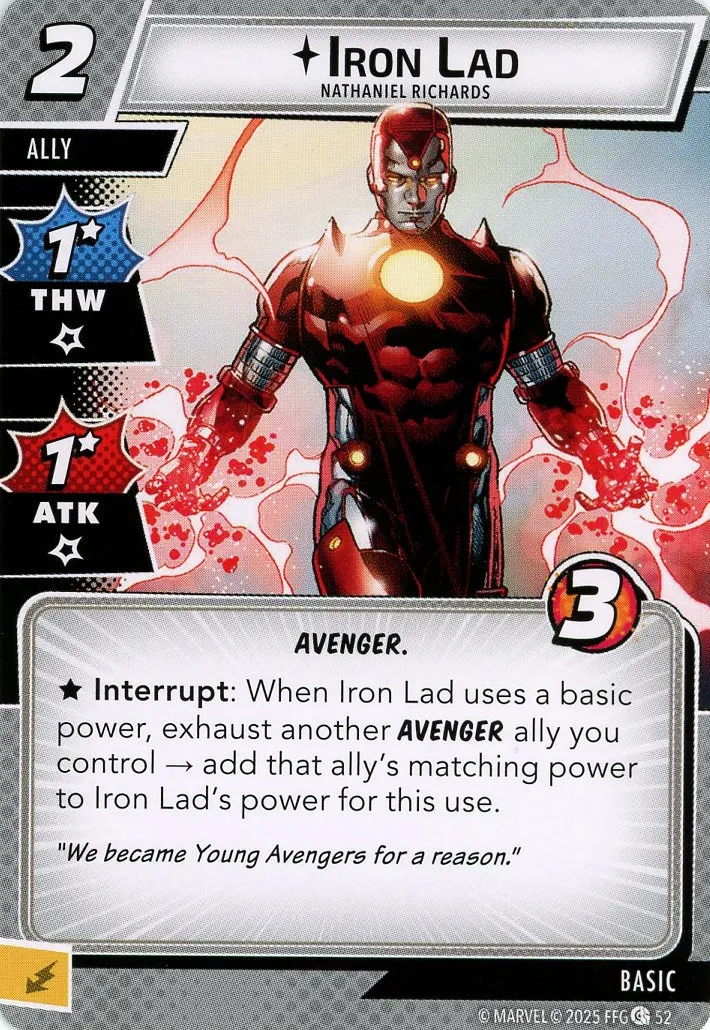
Iron Lad is the Young Avengers’ answer to Iron Man—a teen genius who can tap into the powers of those around him via a complex download process.
Fair warning: if you own the Kang pack for Marvel Champions, you may know he becomes a true villain. This is told in Young Avengers vol 1.
Patriot
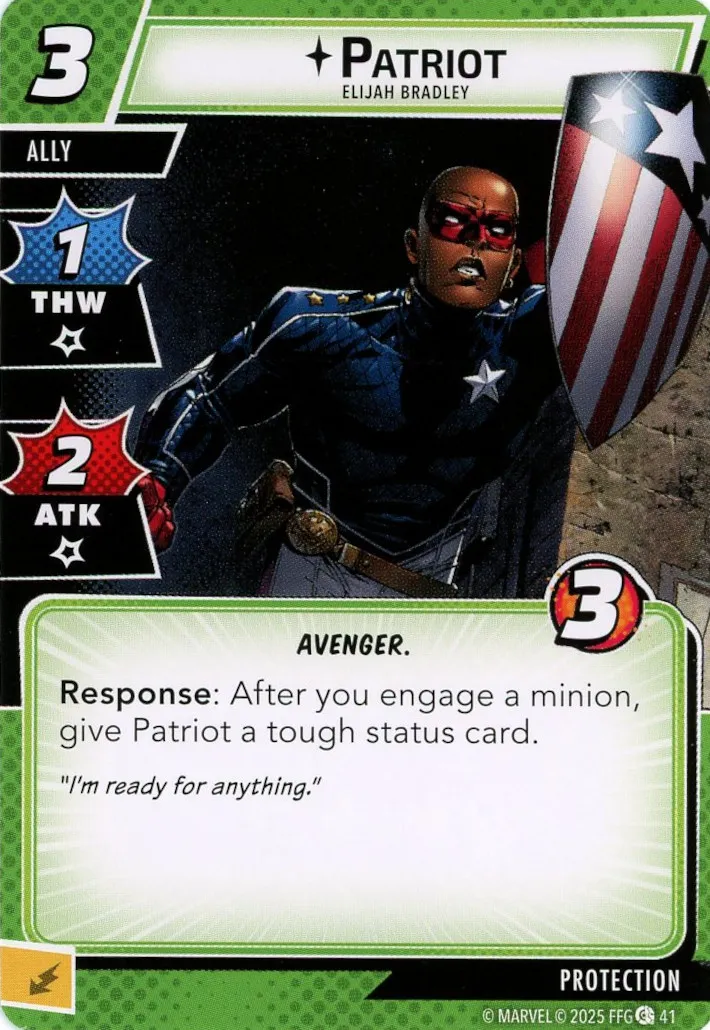
Patriot is the Captain America of the Young Avengers. At first, he has no actual powers—when danger strikes, he secretly takes performance-enhancing drugs to gain super-resistance.
With Patriot’s inclusion, we can now assemble the complete Young Avengers Volume 1 roster in our game—though not in the same deck. Kate Bishop is in Leadership, Billy is in Justice, Eli is in Protection, and Nate is neutral. So perhaps a Hulkling ally card will land in Aggression? Could this be a hidden clue?
Hidden base
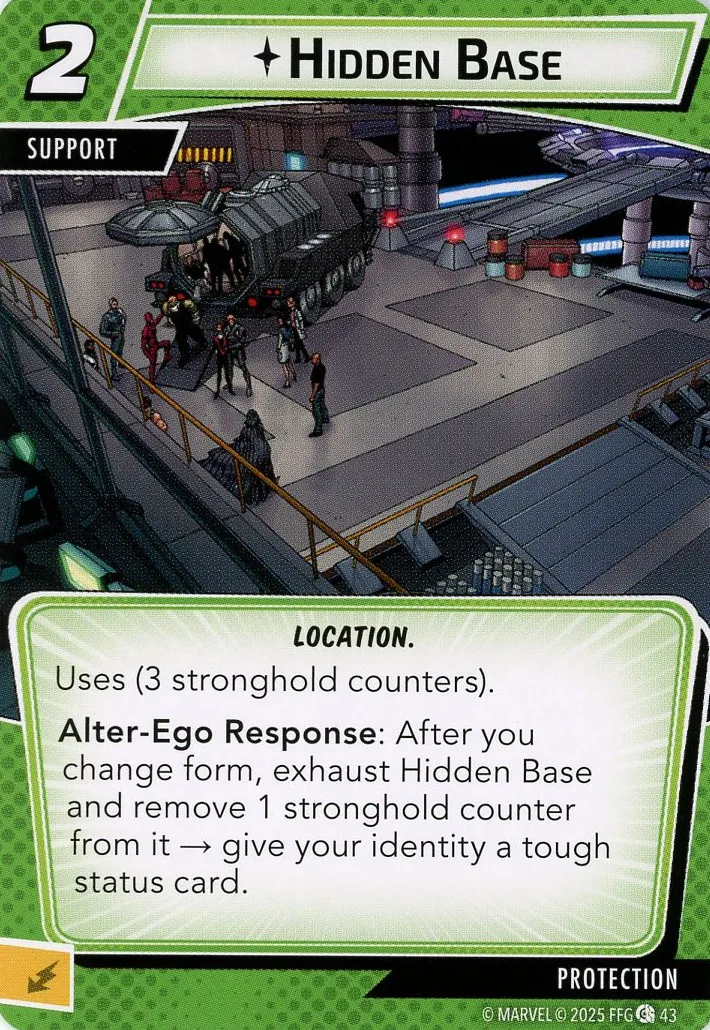
If you look closely — magnifying glass recommended — you can spot Hulkling exiting from a pro-registration prisoner transport. In the comics, he’d been arrested, but during the transfer, Daredevil and Luke Cage (both visible in the image too) managed to reroute the vehicle to a secret safehouse on loan from Nick Fury.
It’s a cool nod, especially with the Defenders arriving in the very next wave. I hope this card will have some synergy with those characters.
Mechanically, a pit stop at this base lets you rearm and regroup. This card is extremely good.
I can do this all day
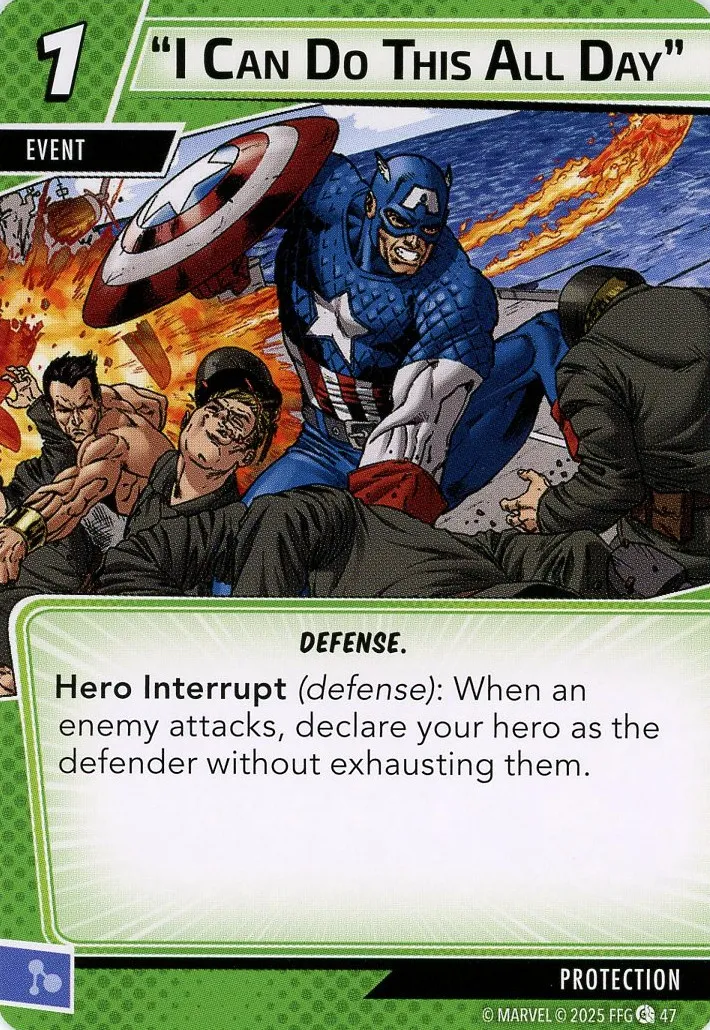
It’s a famous taunt quote from Captain America in the MCU. :)
Excelsior
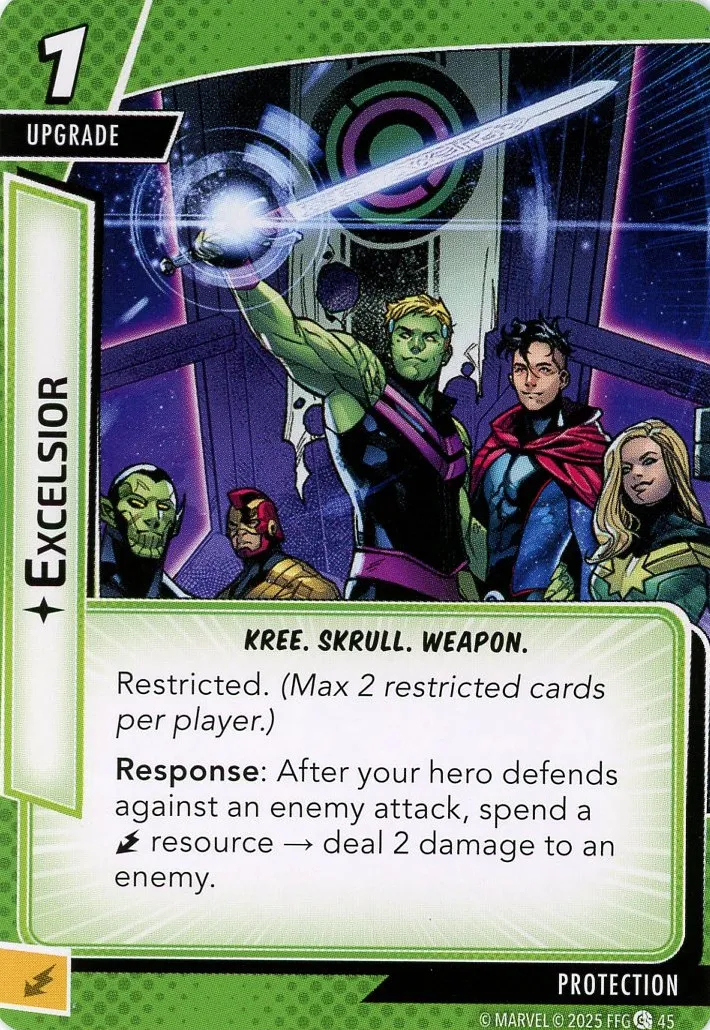
This beautiful illustration is the final page of the Empyre crossover event from 2019. Excelsior is a mythical blade forged from the union of two ancestral swords — one Kree, one Skrull. According to legend, it has the power to bring peace and unite both empires.
Teddy earns the right to wield it by conquering a trial, and in doing so becomes Emperor of both the Kree and Skrull Empires.
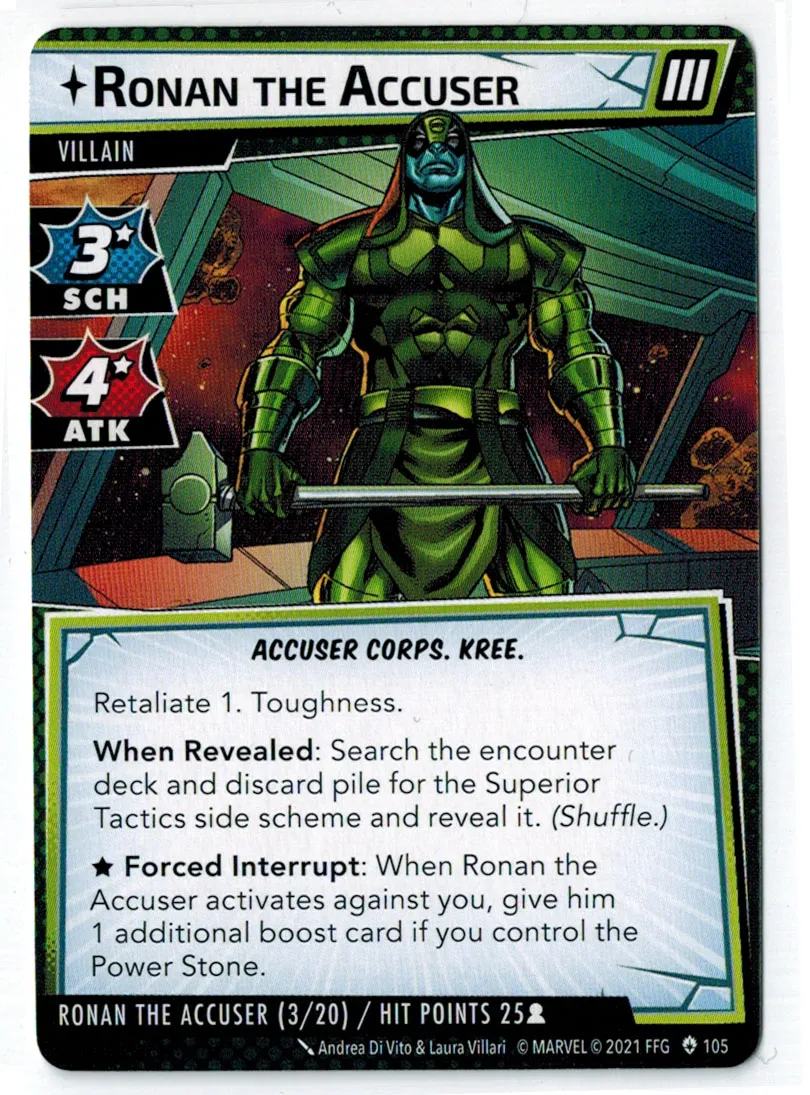
In the image, we can see the Super-Skrull, and Billy serving as First Gentleman and Carol Danvers. Carol, who is also part Kree, takes on the mantle of Accuser, a role made infamous in our game by Ronan, the final boss of the Galaxy Most Wanted box. Mechanically, it works like Jarnbjorn or Godslayer: 2 damage, straightforward and effective.
Fun fact: Excelsior is a latin expression frequently used by Stan Lee who founded Marvel.
My 2 cts
The story told through these cards maps perfectly onto the character. Everything is here, except maybe a couple of rainbow flags, but the choice to feature this gay icon is already a strong editorial statement.
The hero plays powerfully whether you’re constantly shifting shapes or sticking with your favorite form all game. It tells the right Skrull story, though players unfamiliar with the lore who expect to alwaus shapeshift every turn might find the mechanics underwhelming.
Nevertheless, I thoroughly enjoyed both playing and reading Hulkling and I never would have discovered him without Marvel Champions.
Reading guide
If you only have a couple of hours to discover Hulkling, you can’t go wrong with Empyre (2020) from Ewing. It’s a universally acclaimed story spanning just five issues, and it conveniently summarizes Hulkling’s entire journey in only 4 beautiful pages. He’s a central character throughout, and the event ties into the Krakoa-era X-Men, the Fantastic Four, the Avengers… I can’t recommend it enough.
If you’re in the mood for something more whimsical afterward, Young Avengers (2005) is short and sweet. Then there’s Civil War, which is helpful context for the whole box—but while Hulkling plays an instrumental role, he’s far from central to that story.