Getting from ER to There
To compare the efficiency of effects, we use the concept of effective resources (ER). Playing Emergency, a 0-cost event (the printed number), costs you 1ER, you lost the card itself that could have been used as a resource. Mockingbird or Tigra are 4ER.
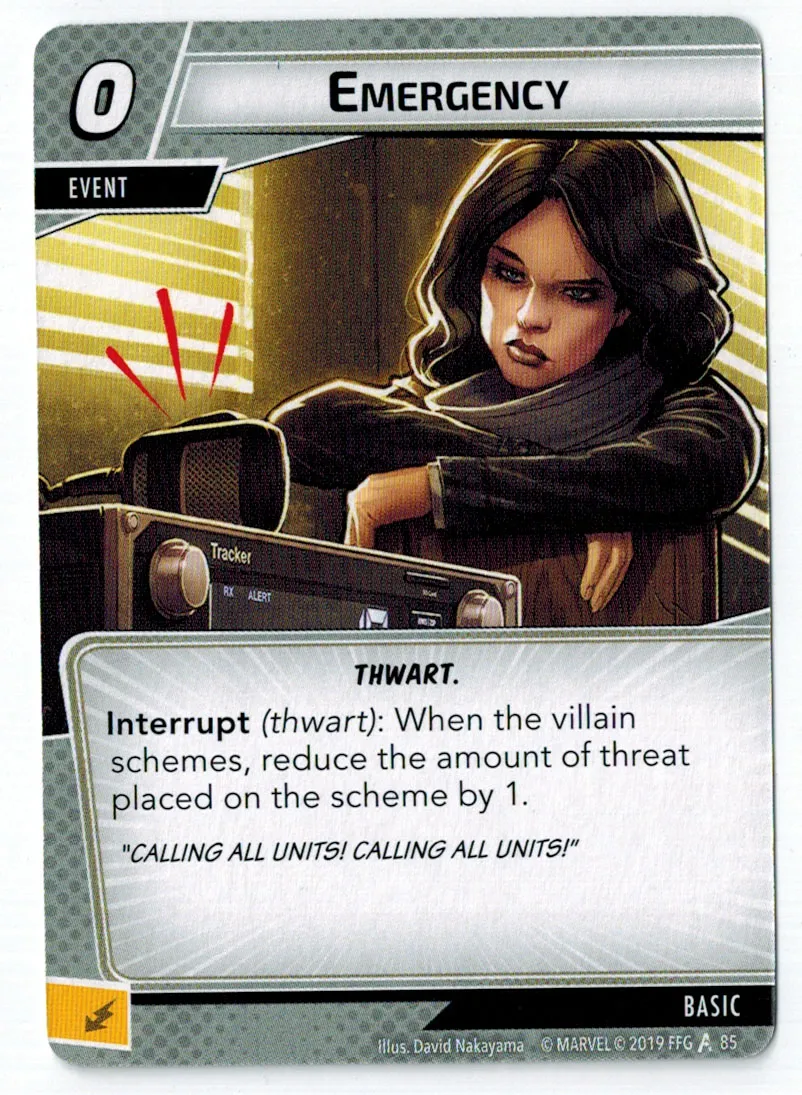
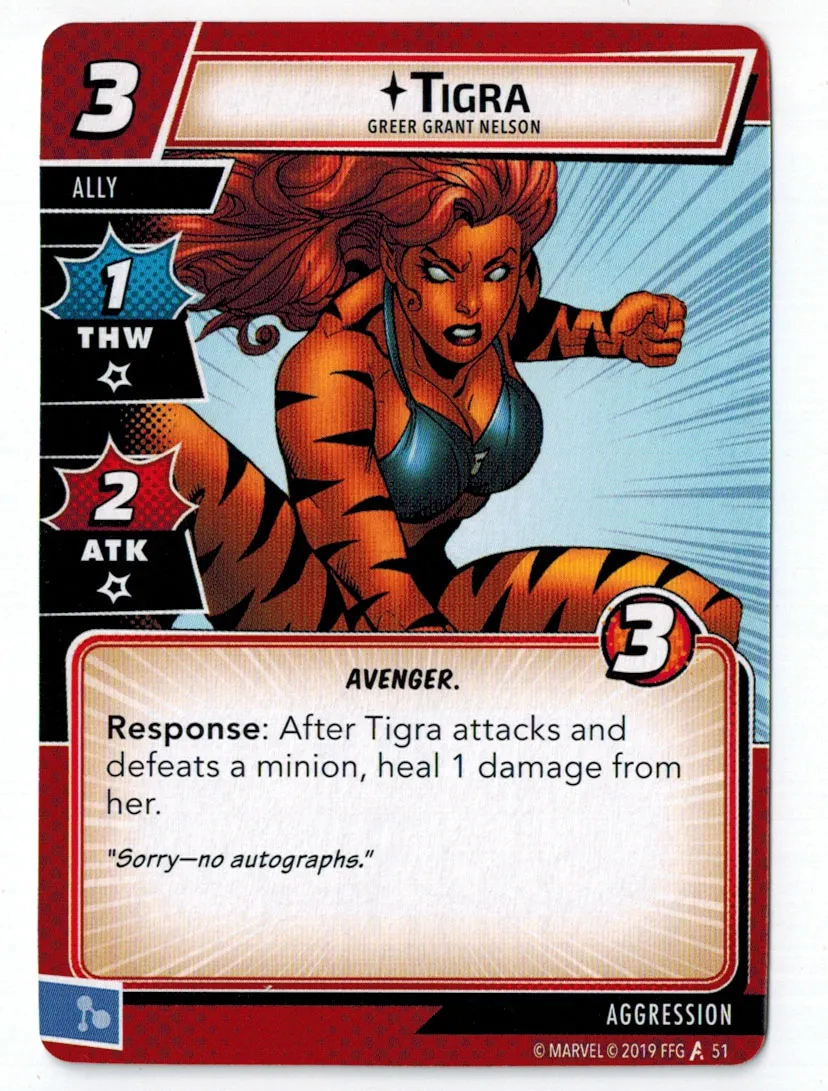
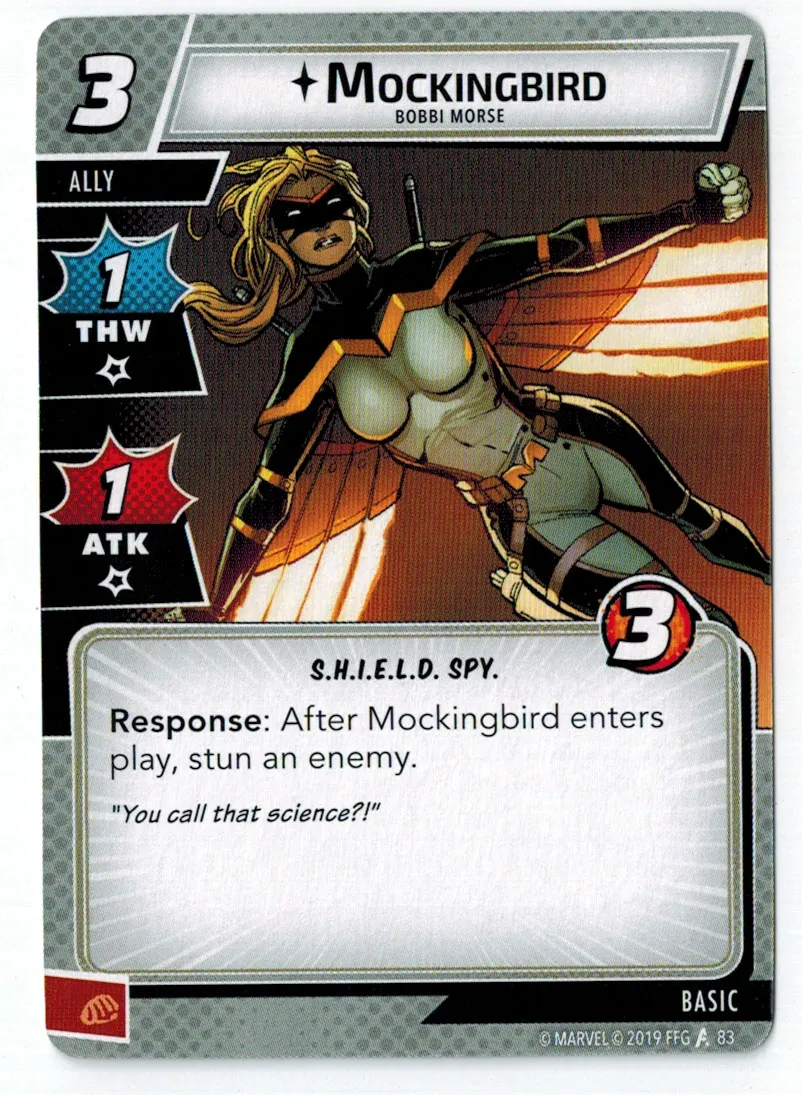

Effective Resources is computed by adding 1 to the printed cost of a card.
Ratios
When we know the true cost of a card, we can evaluate its efficiency. Sure Haymaker does 3 damage for 3ER. And Uppercut deals 5 damage for 4ER. It comes naturally to compute ratios:
- Haymaker deals 3dmg for 3ER -> 1 dmg/ER.
- Uppercut deals 5dmg for 4ER -> 1.25 dmg/ER.
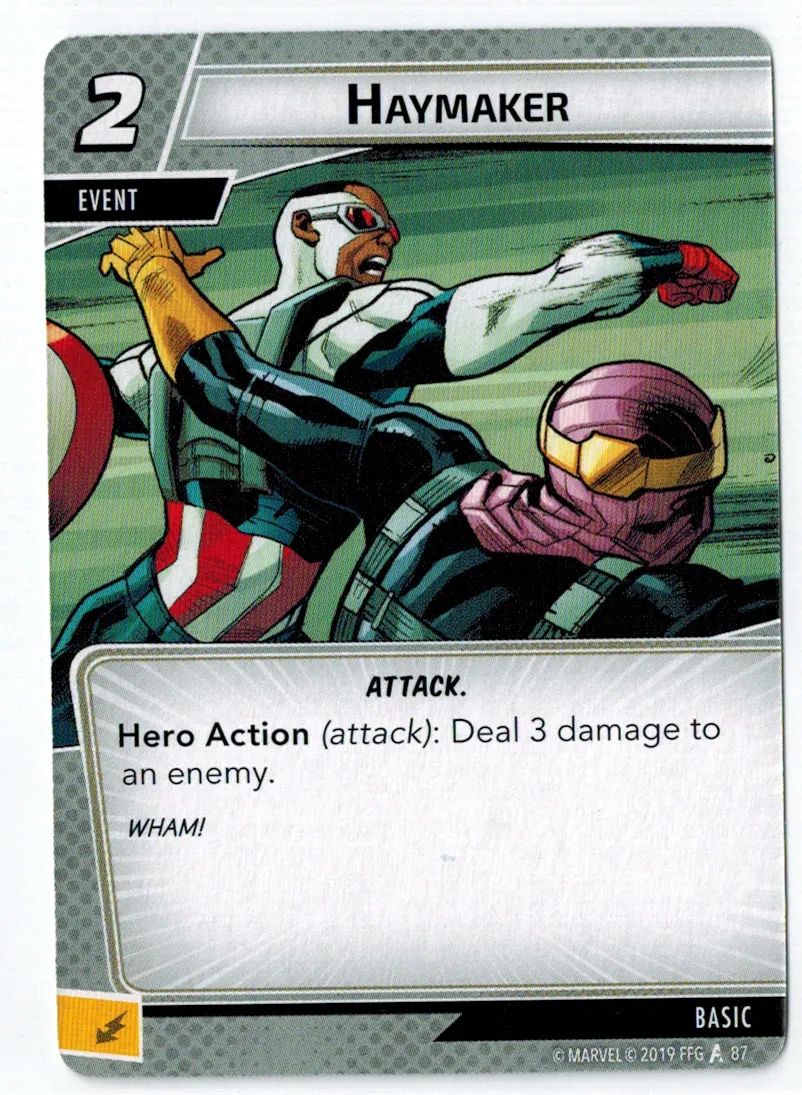
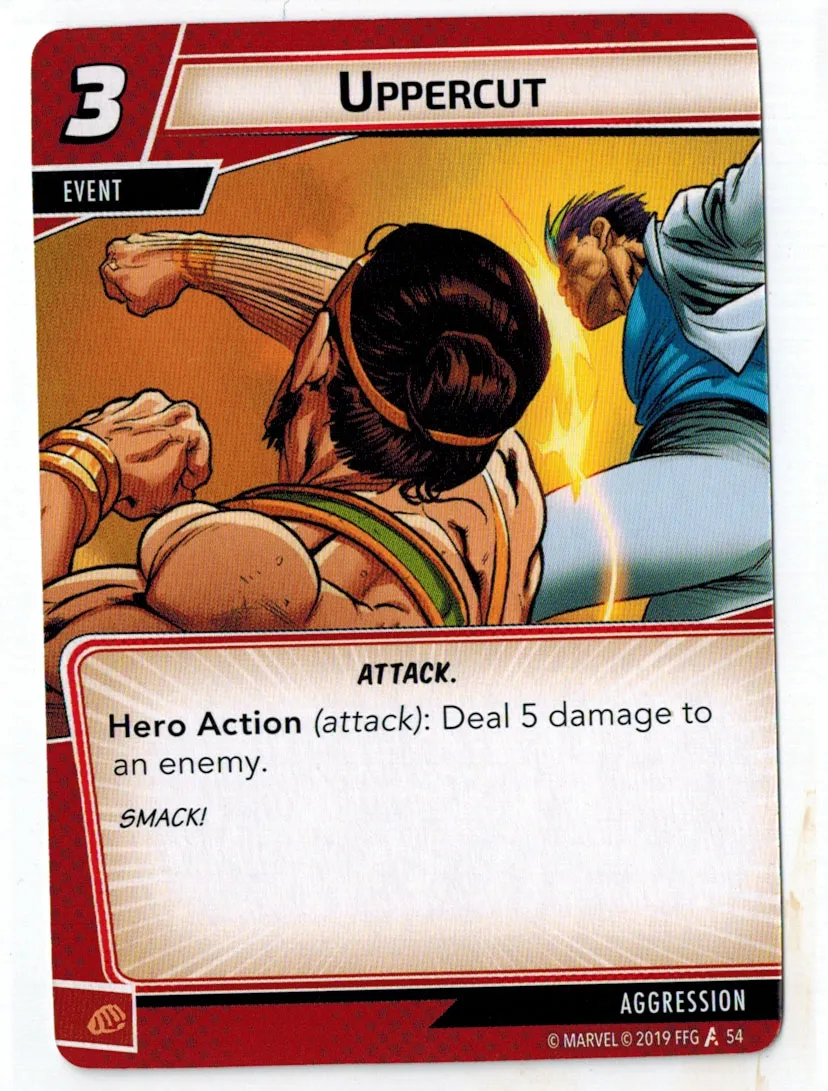
Therefore Uppercut deals more damage for your buck. Does this mean Uppercut is better? If you only need to take a 3 HP minion, obviously not, Uppercut costs 1 more for no reason. But if we need to takedown a 20 HP villain, killing with Uppercuts cost 16ER, Haymaker 20ER.

It is common to consider the ratio of an ally as:
stronger stat * (number of hp - 1)/(printed cost - 1)It integrates chump blocking directly in.
So Tigra is worth 2 atk * (3-1)hp / (4-2)ER = 2dmg/ER.
This very good ratio and their flexibility make allies the most efficient type of card in the game.
It’s sometimes important to evaluate raw efficiency in a vacuum, and ER ratios are here for that.
I will now give you the stereotypical ratios of player cards as of 2025. Each aspect has different ratios.
Without further ado, the ratios:
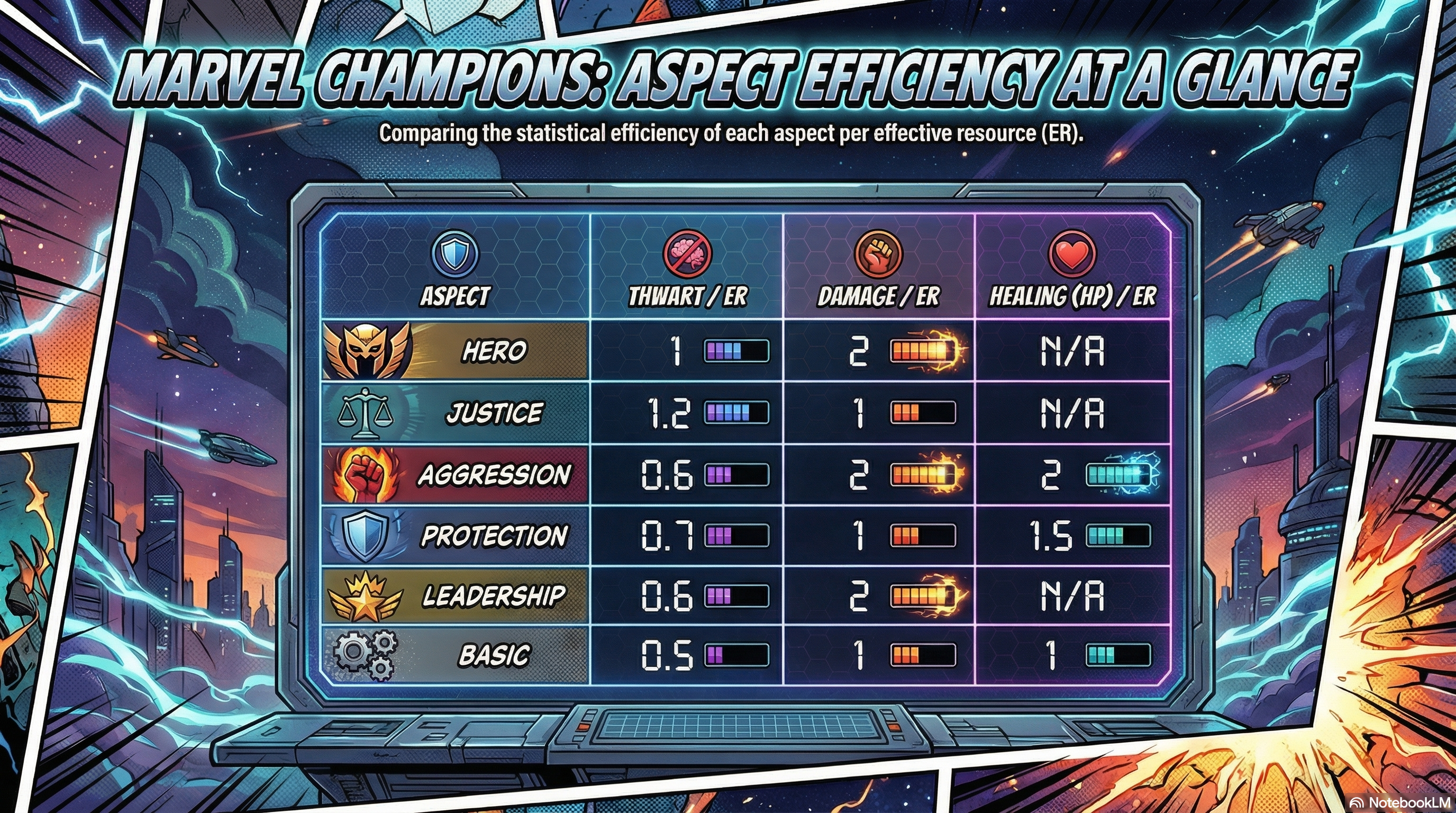
I made some hypothesis:
- 1DEF is worth 1HP.
- an encounter card has 2 boost on it
- a player card has 1 resource icon on it
- conditional bonuses are realized at 50% of their value
The limits of ratios
Some players dismiss cards based solely on their poor ratio. I remember Pericles being written off as terrible, ignoring both its power to stabilize the early game and the fact that combos can return tokens to it. So here are a few caveats:
- Ratios don’t account for tempo. Leadership has great ratios, but it takes many turns to use all those activations.
- Ratios don’t account for hand quality. If you can only remove 10 threat per turn for 5 ER, the ratio looks amazing—but you’ll lose as you can’t deal damage.
- Ratio ignores the conditions a card require to be played.
- Ratios don’t account for flexibility. A Sonic Rifle may be slightly expensive, but having confuse-on-a-stick is invaluable.
- Finally—and this is the strongest argument against pure ratio thinking—ratios ignore thresholds. Thwarting for 3 isn’t just 50% better than 2; a single card can deal with far more situations all by itself. In the core set, 2 thwarts will be able to finish 2 out 18 side schemes in one go, while 3 thwart handles 12 out of 18.
As such, learn to compute ratios, but always consider the tempo, hand quality, conditions, flexibility, and thresholds of a card as well.