What a pain
What a villain asks of you every turn, what you can answer, and the gap between the two.
In this article · 5 sections
You flip the villain’s encounter card, and it hurts. This article tries to quantify how much pain each encounter card deals.

I’m only here for the fine print, and I’m afraid reality is not mine to bend today. The numbers are averages: they hide the variance, what players call the “swinginess” of a villain. We only evaluate the cost of cards, not what makes you lose. The main scheme running to its end, your hit points falling to zero: those clocks are left out of the system. I’d love to rewrite that, but right now we’re limited.
Over the course of three articles, we will discuss encounter cost, debt and tempo. This first article defines a cost for encounter effects. The second looks at how this cost is spread across a game - that’s when we talk about stabilization, debt and early pressure. The third discusses strategies with this new intel, and in particular, tempo.
Step 1: The pain
On your turn, the villain does three things to you:
- the acceleration on the main scheme adds threat,
- he activates against you, often it is an attack,
- you reveal an encounter card: a minion, a side scheme, an attachment, a nasty treachery.
Each of these is a different kind of problem. Threat is removed by thwarting. An attack is defended, prevented and/or healed. An encounter card can be anything. To rank how difficult they are, they need the same unit.
Step 2: An encounter cost
Definition
Threat, attacks and encounter cards are different problems, but I found a way to compare them. I call it the encounter cost, written EC: it is simply the value in ER of undoing an encounter effect. It is only a way to compare how dangerous they are. EC is the price of undoing an effect exactly. In a real game you don’t always undo perfectly: you overkill a minion, you thwart more than you needed, you sometimes have to overspend. The real cost of a card is at least its EC, never less. A side scheme of 3 threat costs 3EC, because removing 3 threat is worth 3ER. I use EC for everything on the villain’s side of this series.
Here is my EC table. By definition, every price comes from the ER of the same effect, and What is an ER? derives the prices of threat, damage and healing from core set cards. The price of a hit point has its own article.
| Effect | Price | What it prices |
|---|---|---|
| 1 threat | 1EC | threat on a scheme |
| 1HP on a minion | 0.5EC | the minions you have to kill |
| 1 tough on a minion | 0.5EC | a tough status, which takes a hit to remove |
| 1HP to heal | 0.7EC | the damage you take. The price of a good healing card, with flipping back to alter-ego to recover folded in. |
| 1 exhaust or activation | 2EC | the cards that exhaust you |
| 1 heal on the villain | 0.5EC | the damage you have to deal again, which delays your victory: more turns, and more encounter cards |

You may want different costs for your deck. A deck that defends, recovers or thwarts well will change the ER and therefore the EC. I offer a tool to edit this table and compute the encounter cost of a few hand-picked scenarios.
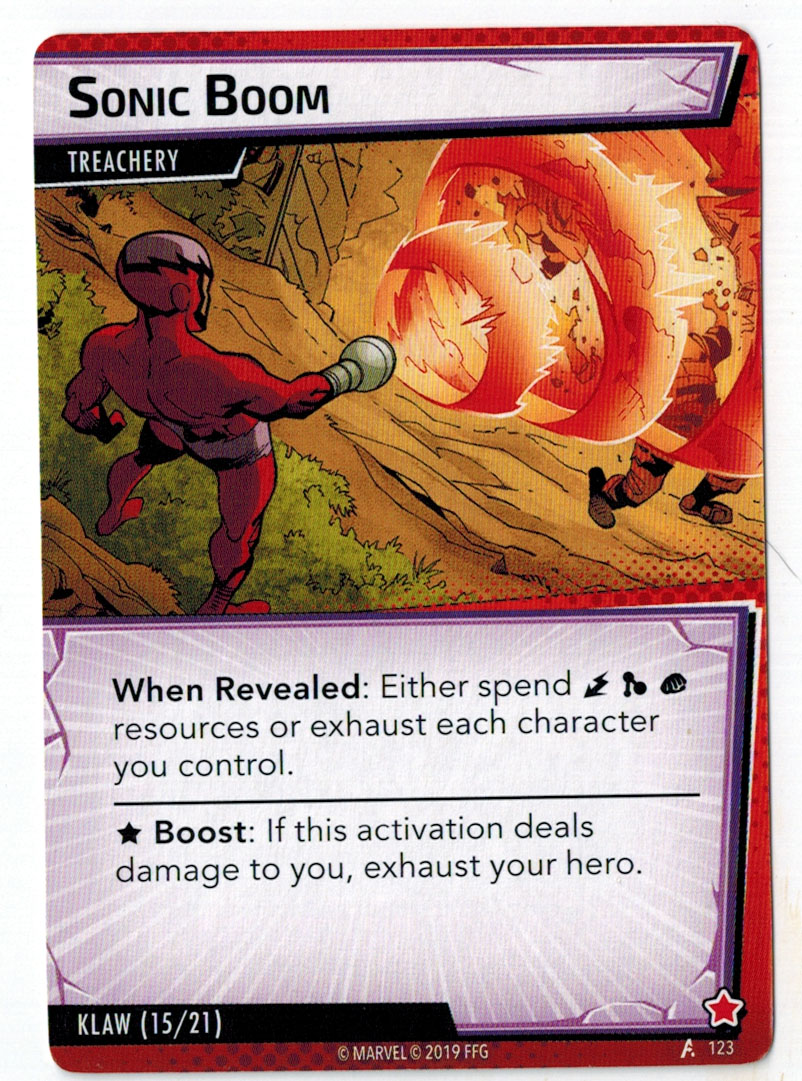
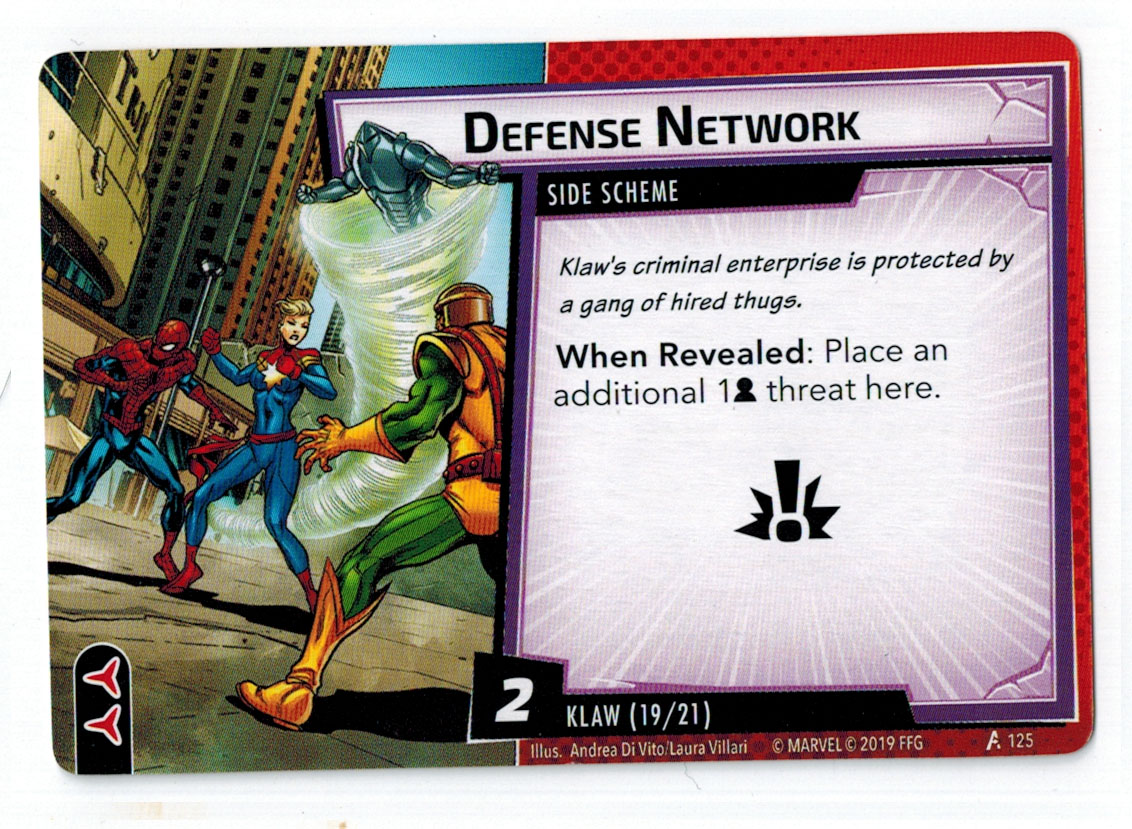
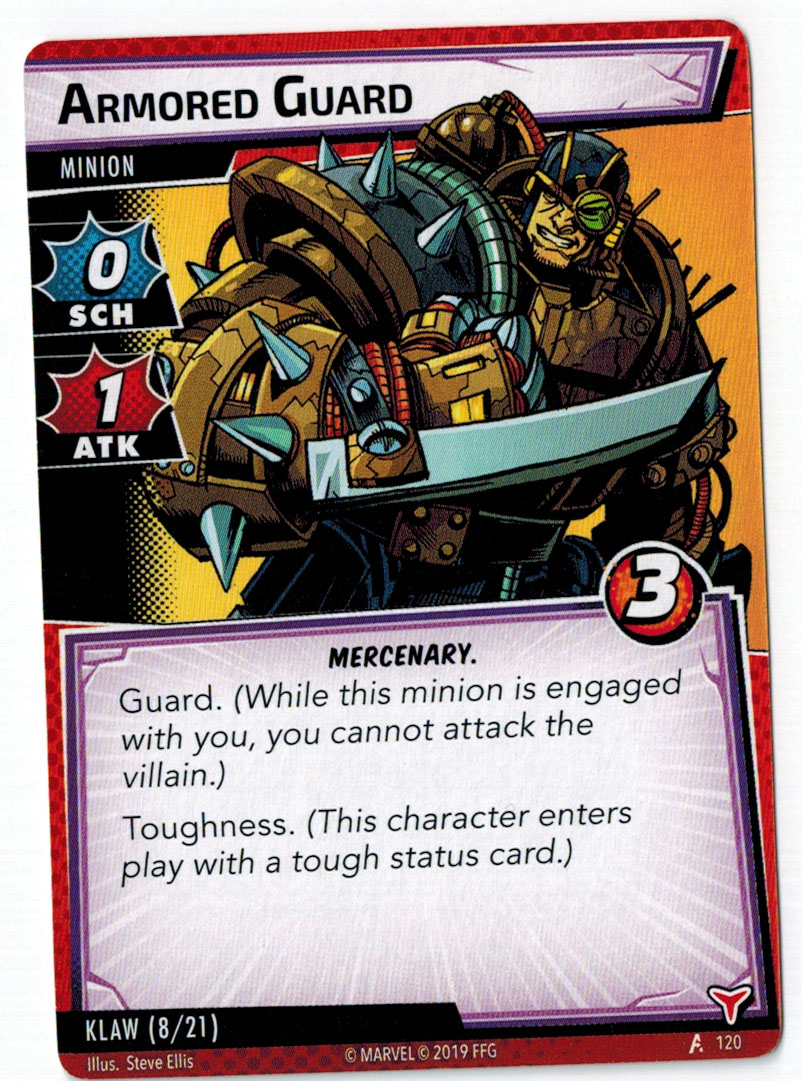
Here are three cards from Klaw’s deck, to see how the EC works.
Interest in EC
Some encounter cards do not stop there, they aren’t one and done. A minion stays in play, and a side scheme stays on the table: they keep costing you every turn until you deal with them. I call this the encounter interest: the EC a card costs each turn it stays in play without being dealt with.
- A minion attacks you every turn it is engaged with you. With 1 attack, that is 1 HP, so 0.7EC a turn.
- An acceleration icon on a side scheme adds 1 threat to the main scheme every turn, and removing a threat is worth 1EC: so 1EC a turn.
- A treachery is played once and discarded. It has no interest.

A card left in play for n turns costs its EC plus n times its interest. The Armored Guard, 2EC with 0.7EC of interest, costs 3.4EC if you leave it for two turns.
The sooner you deal with a card that has interest, the less it costs you. Two of the cards above, with their interest:

Surge in EC
A surge makes you reveal one more random encounter card, which has a random EC. I cannot know which card you will reveal, but over several turns many random draws tend to converge to an average EC. Pricing the average EC is a bit difficult, but assume it’s 3.4EC when facing Klaw II Expert for now.
Let’s see 2 cards that need to consider surge EC.

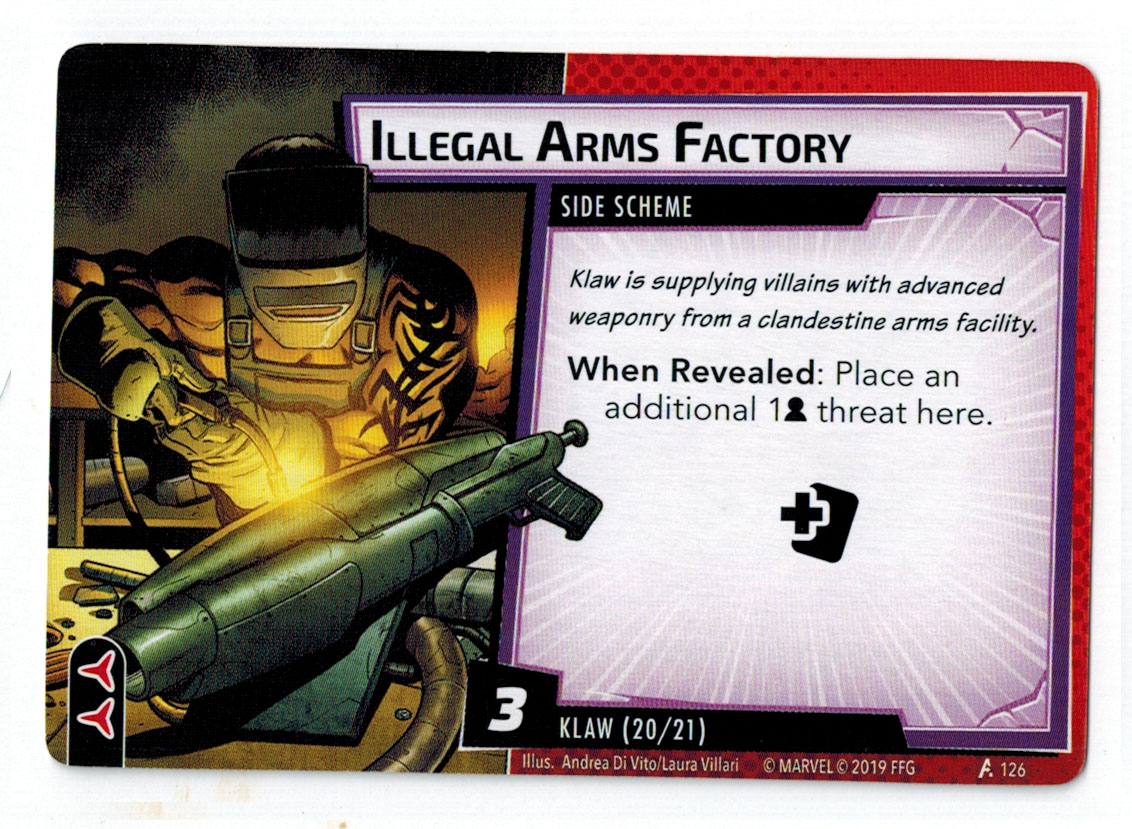
The Illegal Arms Factory costs 4EC to clear, and 3.4EC more for every turn you leave it in play: after two turns, it has cost 10.8EC.
The Illegal Arms Factory is a top priority to get rid of. And we will want to put in play weapons runner instead of revealing it, to lower their EC from 4.4EC to 1EC. But you didn’t need those complicated computation to discover those strategies!
Step 3: Pricing Klaw II
Take Klaw II, the second stage of Klaw, in solo Expert. His turn has three parts.
The threat. His main scheme, Underground Distribution, adds 1 threat a turn: 1EC.
The attack. Klaw II has 1ATK, which is 0.7EC. His own Forced Interrupt gives him 1 additional boost card, so he draws 2 boost cards. Each boost card is worth its boost icons, 1 damage each, and its boost effect. I price both in a column of the deck tables below, Boost EC, and I take the average over the deck, which is 1.04EC.
So the average attack is 0.7EC + 2 × 1.04EC = 2.8EC. For this exercise, damage prevented or defended or healed can be considered the same.
Many cards carry a boost effect, a text that triggers when the card is revealed as a boost, like Whirlwind’s damage to each hero or Melter’s exhausting your allies. I price them like any other effect.
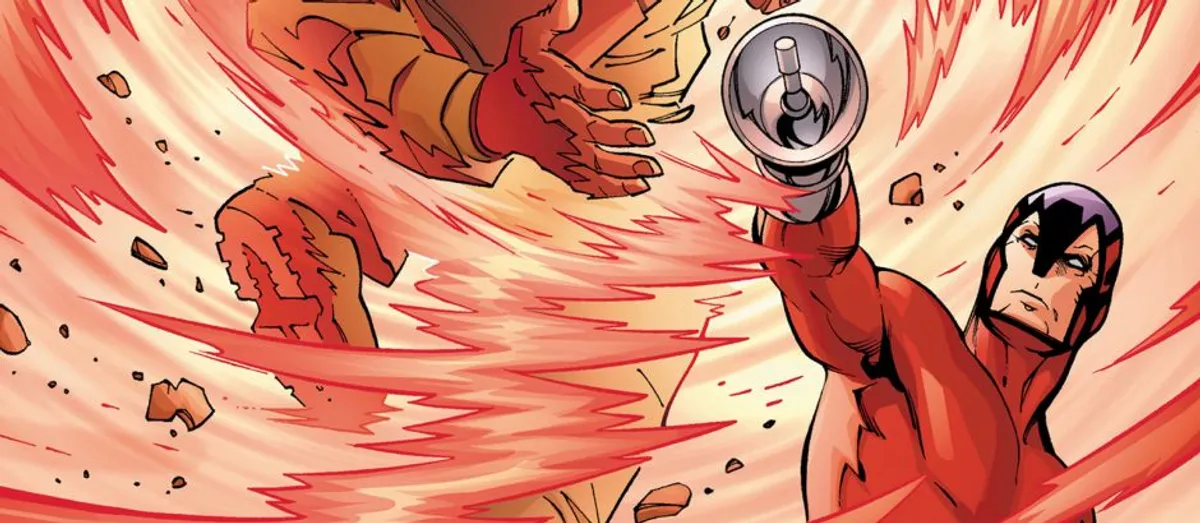
The boost effects of Klaw II’s deck. Weapons Runner (2 copies) puts a minion into play, so it is 1.0EC because we need to deal 2 damage to undo it. Sonic Boom (2) exhausts your hero if the attack damages you, 2.0EC. etc.
I priced every card, set by set, in numbering order. The sets of Klaw II’s deck are Klaw, Masters of Evil, Standard and Expert. Two cards of the Klaw set never come from the deck: Defense Network is revealed at setup, and The “Immortal” Klaw by his second stage, so they are set aside. Shadow of the Past reveals your own nemesis, which depends on your hero, so I leave it out.
The deck of Klaw II, set by set, card by card
Klaw
| No. | Card | Copies | What it does | How I price one copy | Cost in EC | Boost EC |
|---|---|---|---|---|---|---|
| 01118 | Sonic Converter | 1 | Attached to the villain. Whoever he damages is stunned. You pay 3 resources to discard it | discard: 3 resources | 3.0EC | 2.1EC |
| 01119 | Solid-Sound Body | 1 | Attached to the villain, who gains retaliate 1. You pay 3 resources to discard it | discard: 3 resources | 3.0EC | 2.1EC |
| 01120 | Armored Guard | 3 | Minion, 3HP, tough | 3HP × 0.5 + 0.5 tough | 2.0EC | 0.7EC |
| 01121 | Weapons Runner (surge) | 2 | Minion, 2HP | 2HP × 0.5 | 1.0EC | 1.0EC: puts a Weapons Runner into play |
| 01122 | Klaw’s Vengeance | 2 | The villain attacks you, and adds 1 threat if he damages you | his attack + 1 threat | 3.8EC | 0.7EC |
| 01123 | Sonic Boom | 2 | You spend 3 resources, or exhaust each of your characters | 3 resources | 3.0EC | 2.0EC: exhausts your hero if the attack damages you |
| 01124 | Sound Manipulation | 2 | You take 2 damage, and the villain heals 2 | 2HP × 0.7 + 2 heals × 0.5 | 2.4EC | 1.4EC |
| 01125 | Defense Network | 1 | Side scheme, 2 threat + 1 per hero | 3 threat | set aside | set aside |
| 01126 | Illegal Arms Factory | 1 | Side scheme, 3 threat + 1 per hero, hazard icon | 4 threat | 4.0EC | 1.4EC |
| 01127 | The “Immortal” Klaw | 1 | Side scheme, 3 threat, acceleration icon | 3 threat | set aside | set aside |
Masters of Evil
| No. | Card | Copies | What it does | How I price one copy | Cost in EC | Boost EC |
|---|---|---|---|---|---|---|
| 01128 | The Masters of Evil | 1 | Side scheme, 3 threat, and a Masters of Evil minion comes in | 3 threat + the average spawn | 6.0EC | 1.4EC |
| 01129 | Radioactive Man | 1 | Minion, 7HP | 7HP × 0.5 | 3.5EC | 1.2EC: discards a card at random |
| 01130 | Whirlwind | 1 | Minion, 6HP | 6HP × 0.5 | 3.0EC | 0.7EC: 1 damage to each hero |
| 01131 | Tiger Shark | 1 | Minion, 6HP | 6HP × 0.5 | 3.0EC | 0.5EC: gives the villain a tough status |
| 01132 | Melter | 1 | Minion, 5HP | 5HP × 0.5 | 2.5EC | 0.0EC |
| 01133 | Masters of Mayhem | 2 | Each Masters of Evil minion attacks, or one comes in | the average spawn | 3.0EC | 1.4EC |
Standard
| No. | Card | Copies | What it does | How I price one copy | Cost in EC | Boost EC |
|---|---|---|---|---|---|---|
| 01186 | Advance | 2 | The villain schemes | his scheme | 3.4EC | 0.0EC |
| 01187 | Assault | 2 | The villain attacks you | his attack | 2.8EC | 0.0EC |
| 01188 | Caught Off Guard | 1 | You discard an upgrade or a support | an upgrade or a support: 2 resources + the card | 3.0EC | 0.7EC |
| 01189 | Gang-Up | 1 | The villain and each engaged minion attack you | his attack + 1 minion attack | 3.5EC | 0.7EC |
| 01190 | Shadow of the Past | 1 | Reveals your nemesis, which depends on your hero | depends on your hero | not priced | 1.4EC |
Expert
| No. | Card | Copies | What it does | How I price one copy | Cost in EC | Boost EC |
|---|---|---|---|---|---|---|
| 01191 | Exhaustion (surge) | 1 | You exhaust your identity card | 1 exhaust | 2.0EC | 1.4EC |
| 01192 | Masterplan | 1 | 4 threat on each side scheme | 4 threat, with 1 side scheme in play | 4.0EC | 1.4EC |
| 01193 | Under Fire (surge) | 1 | Reveals the top card of the deck | one more card of this deck: the average | 3.4EC, the average card | 2.1EC |
The deck has 30 cards. 26 of them end a turn, and they cost 81.1EC in total. The 4 others are surges: two Weapons Runners at 1.0EC and Exhaustion at 2.0EC, which cost 4.0EC, and Under Fire.
The total is the cost of every card of the cycle: 81.1EC + 4.0EC = 85.1EC. A turn ends on the first card that does not surge, so a cycle is 25 turns long. The average is 85.1EC / 25 = 3.4EC a turn. I checked it by playing 400,000 turns of the deck.
The total encounter cost of Klaw II on a turn.
- 1EC of threat,
- 2.8EC of attack,
- 3.4EC of encounter card:
Klaw II costs 7.2EC a turn.
Step 4: Two more villains, and the standard mode
The same three parts, priced the same way, for two other villains. Each has its own deck, priced card by card like Klaw II’s, and its own average boost card: 0.79EC for Rhino’s deck with Bomb Scare, 1.12EC for Ronan’s with Kree Militants.
Rhino is a straightforward brute. His main scheme adds 1 threat a turn, he draws 1 boost card, and his ATK is 3 in stage II and 4 in stage III. That is 3 × 0.7EC + 0.79EC = 2.9EC in stage II, and 4 × 0.7EC + 0.79EC = 3.6EC in stage III. None of his cards has a boost effect. His deck is cheap, 2.5EC a card in stage II: small minions, and cards that heal or shield him, which I price at 0.5EC per HP healed, since they delay your victory.
The deck of Rhino II, set by set, card by card
Rhino
| No. | Card | Copies | What it does | How I price one copy | Cost in EC | Boost EC |
|---|---|---|---|---|---|---|
| 01098 | Armored Rhino Suit | 1 | Attached to the villain. The next 5 damage to him go here instead | 5 heals × 0.5 | 2.5EC | 0.0EC |
| 01099 | Charge | 2 | Attached to the villain. His next attack gains +3 ATK and overkill | +3 ATK × 0.7 | 2.1EC | 1.4EC |
| 01100 | Enhanced Ivory Horn | 1 | Attached to the villain, +1 ATK. You pay 3 resources to discard it | discard: 3 resources | 3.0EC | 1.4EC |
| 01101 | Hydra Mercenary | 2 | Minion, 3HP, guard | 3HP × 0.5 | 1.5EC | 0.7EC |
| 01102 | Sandman | 1 | Minion, 4HP, tough | 4HP × 0.5 + 0.5 tough | 2.5EC | 1.4EC |
| 01103 | Shocker | 1 | Minion, 3HP, and 1 damage to each hero | 3HP × 0.5 + 1HP × 0.7 | 2.2EC | 1.4EC |
| 01104 | Hard to Keep Down | 2 | The villain heals 4 | 4 heals × 0.5 | 2.0EC | 0.0EC |
| 01105 | ”I’m Tough” | 2 | The villain gets a tough status | 1 tough | 0.5EC | 0.0EC |
| 01106 | Stampede | 3 | The villain attacks you, and stuns whoever he damages | his attack | 2.9EC | 0.7EC |
| 01107 | Breakin’ & Takin’ | 1 | Side scheme, 2 threat + 1 per hero, hazard icon | 3 threat | set aside | set aside |
| 01108 | Crowd Control | 1 | Side scheme, 2 threat per hero, crisis icon | 2 threat | 2.0EC | 1.4EC |
Bomb Scare
| No. | Card | Copies | What it does | How I price one copy | Cost in EC | Boost EC |
|---|---|---|---|---|---|---|
| 01109 | Bomb Scare | 1 | Side scheme, 2 threat + 1 per hero, acceleration icon | 3 threat | 3.0EC | 1.4EC |
| 01110 | Hydra Bomber | 2 | Minion, 2HP, and 2 damage to you or 1 threat | 2HP × 0.5 + 1 threat | 2.0EC | 0.7EC |
| 01111 | Explosion | 1 | Damage to you equal to the threat on Bomb Scare, if it is in play | 3 damage × 0.7 | 2.1EC | 1.4EC |
| 01112 | False Alarm | 2 | You are confused | 1 activation | 2.0EC | 0.7EC |
Standard
| No. | Card | Copies | What it does | How I price one copy | Cost in EC | Boost EC |
|---|---|---|---|---|---|---|
| 01186 | Advance | 2 | The villain schemes | his scheme | 2.1EC | 0.0EC |
| 01187 | Assault | 2 | The villain attacks you | his attack | 2.9EC | 0.0EC |
| 01188 | Caught Off Guard | 1 | You discard an upgrade or a support | an upgrade or a support: 2 resources + the card | 3.0EC | 0.7EC |
| 01189 | Gang-Up | 1 | The villain and each engaged minion attack you | his attack + 1 minion attack | 3.6EC | 0.7EC |
| 01190 | Shadow of the Past | 1 | Reveals your nemesis, which depends on your hero | depends on your hero | not priced | 1.4EC |
Expert
| No. | Card | Copies | What it does | How I price one copy | Cost in EC | Boost EC |
|---|---|---|---|---|---|---|
| 01191 | Exhaustion (surge) | 1 | You exhaust your identity card | 1 exhaust | 2.0EC | 1.4EC |
| 01192 | Masterplan | 1 | 4 threat on each side scheme | 4 threat, with 1 side scheme in play | 4.0EC | 1.4EC |
| 01193 | Under Fire (surge) | 1 | Reveals the top card of the deck | one more card of this deck: the average | 2.5EC, the average card | 2.1EC |
Ronan costs more in all three parts.
- His threat. His main scheme adds 2 threat a turn: Interception Imminent says so.
- His attack. The Power Stone decides how he hits. If Ronan holds it, he gets +1 ATK. If you hold it, which is the case at setup, he gets 1 additional boost card each time he activates against you. His ATK is 3 in stage II and 4 in stage III. I average the two cases: 4.1EC and 4.8EC.
- His encounter cards. The Kree Command Ship, an environment in play from the start, carries a permanent hazard icon. A hazard icon deals each player 1 additional encounter card, so you reveal 2 a turn, not 1. And his deck is the most expensive of the three, 4.0EC a card in stage II: 5EC side schemes, 2.5EC to 3.5EC minions, and attacks with +1 ATK.
The deck of Ronan II, set by set, card by card
| No. | Card | Copies | What it does | How I price one copy | Cost in EC | Boost EC |
|---|---|---|---|---|---|---|
| 16108 | Kree Command Ship | 1 | Environment, hazard icon, in play at setup | in play at setup | set aside | set aside |
| 16109 | Universal Weapon | 1 | Attached to the villain at setup, stalwart | attached at setup | set aside | set aside |
| 16110 | Fanaticism (surge) | 2 | Attached to the villain: 2 attacks with +1 ATK, overkill and piercing | 2 attacks × +1 ATK × 0.7 | 1.4EC | 1.4EC |
| 16111 | Cut the Power | 1 | Side scheme, 3 threat, crisis icon | 3 threat | set aside | set aside |
| 16112 | Pincer Maneuver | 2 | Side scheme, 3 threat + 2 hinder, 2 acceleration icons | 5 threat | 5.0EC | 2.1EC |
| 16113 | Superior Tactics | 1 | Side scheme, 2 threat, the Power Stone goes to the villain | 2 threat | set aside | set aside |
| 16114 | Single-Minded Fury | 2 | The villain attacks whoever holds the Power Stone | his attack | 4.1EC | 0.7EC: the Power Stone goes to Ronan: +1 ATK |
| 16115 | Kree Physiology (surge) | 2 | The villain is already tough: 1 damage to you | 1HP × 0.7 | 0.7EC | 0.7EC |
| 16116 | ”You Stand Accused!“ | 3 | The villain attacks you with +1 ATK | his attack + 1 ATK × 0.7 | 4.8EC | 1.8EC: one more boost card, and 1 icons |
Kree Militants
| No. | Card | Copies | What it does | How I price one copy | Cost in EC | Boost EC |
|---|---|---|---|---|---|---|
| 16131 | Kree Combat Armor | 1 | Attached to the strongest enemy, −1 damage a hit. You pay 3 resources to discard it | discard: 3 resources | 3.0EC | 1.4EC |
| 16132 | Kree Commando | 3 | Minion, 6HP, patrol | 6HP × 0.5 | 3.0EC | 1.4EC |
| 16133 | Kree Lieutenant | 2 | Minion, 7HP, guard, stalwart | 7HP × 0.5 | 3.5EC | 2.1EC: +3 boost icons on an attack |
| 16134 | Kree Private | 3 | Minion, 5HP, quickstrike | 5HP × 0.5 | 2.5EC | 0.7EC |
Ship Command
| No. | Card | Copies | What it does | How I price one copy | Cost in EC | Boost EC |
|---|---|---|---|---|---|---|
| 16142 | Milano | 1 | Support in play at setup | in play at setup | set aside | set aside |
| 16143 | Rogue Vessel (surge) | 1 | Environment: 1 damage to each player a turn. You pay 2 resources and exhaust the Milano to discard it | 2 resources + the Milano’s 2ER | 4.0EC | 1.4EC |
| 16144 | Cannonade | 1 | Side scheme, 3 threat per hero | 3 threat | 3.0EC | 1.4EC |
| 16145 | Blind Side | 1 | You exhaust the Milano, or spend 2 resources, or the first player is stunned | the cheapest: 2 resources | 2.0EC | 0.7EC |
| 16146 | Hull Breach | 1 | You exhaust the Milano, or spend 2 resources, or take 3 damage | the cheapest: 2 resources | 2.0EC | 1.4EC |
| 16147 | Power Siphon | 1 | You exhaust the Milano, or spend 2 resources, or discard a card | the cheapest: 1 card | 1.2EC | 0.7EC |
| 16148 | Special Delivery | 1 | You exhaust the Milano, or the villain attacks you with +1 ATK | the cheapest: the Milano | 2.0EC | 0.0EC |
Standard
| No. | Card | Copies | What it does | How I price one copy | Cost in EC | Boost EC |
|---|---|---|---|---|---|---|
| 01186 | Advance | 2 | The villain schemes | his scheme | 3.5EC | 0.0EC |
| 01187 | Assault | 2 | The villain attacks you | his attack | 4.1EC | 0.0EC |
| 01188 | Caught Off Guard | 1 | You discard an upgrade or a support | an upgrade or a support: 2 resources + the card | 3.0EC | 0.7EC |
| 01189 | Gang-Up | 1 | The villain and each engaged minion attack you | his attack + 1 minion attack | 4.8EC | 0.7EC |
| 01190 | Shadow of the Past | 1 | Reveals your nemesis, which depends on your hero | depends on your hero | not priced | 1.4EC |
Expert
| No. | Card | Copies | What it does | How I price one copy | Cost in EC | Boost EC |
|---|---|---|---|---|---|---|
| 01191 | Exhaustion (surge) | 1 | You exhaust your identity card | 1 exhaust | 2.0EC | 1.4EC |
| 01192 | Masterplan | 1 | 4 threat on each side scheme | 4 threat, with 1 side scheme in play | 4.0EC | 1.4EC |
| 01193 | Under Fire (surge) | 1 | Reveals the top card of the deck | one more card of this deck: the average | 4.0EC, the average card | 2.1EC |
The Milano that appears in some of his cards is a support you control from the start. It is part of what you can answer, so the next article counts it.
Standard mode. In standard mode, you face stage I, and the Expert set is not shuffled into the deck: Exhaustion, Masterplan and Under Fire are out, and the villain’s own stage no longer sets aside a side scheme. The boost card is cheaper too: 0.94EC for Klaw I, 0.72EC for Rhino I and 1.05EC for Ronan I. The average encounter card is 3.0EC for Klaw I, 2.1EC for Rhino I and 3.4EC for Ronan I. Klaw I has 0ATK and still draws 2 boost cards: 2 × 0.94EC = 1.9EC. Rhino I has 2ATK and 1 boost card: 2 × 0.7EC + 0.72EC = 2.1EC. Ronan I has 3 or 2ATK depending on the Power Stone, 1 or 2 boost cards, and the same hazard and Milano as in Expert: 3.3EC.
The encounter cost of a villain, in EC a turn, split in three parts.
| Per turn | Threat | Attack | Encounter cards | Encounter cost |
|---|---|---|---|---|
| Rhino I | 1EC | 2.1EC | 2.1EC | 5.2EC |
| Rhino II | 1EC | 2.9EC | 2.5EC | 6.3EC |
| Rhino III | 1EC | 3.6EC | 2.6EC | 7.2EC |
| Klaw I | 1EC | 1.9EC | 3.0EC | 5.9EC |
| Klaw II | 1EC | 2.8EC | 3.4EC | 7.2EC |
| Klaw III | 1EC | 3.5EC | 3.6EC | 8.1EC |
| Ronan I | 2EC | 3.3EC | 6.8EC | 12.2EC |
| Ronan II | 2EC | 4.1EC | 7.9EC | 14.0EC |
| Ronan III | 2EC | 4.8EC | 8.5EC | 15.3EC |
What the encounter costs say
We introduced EC as a measure of the danger of an encounter. Does it hold? EC pictures the progressive difficulty of the stages very well: for each villain, every stage costs more than the one before. And Ronan stands apart, as every player feels it, at about twice the others. His main scheme adds 2 threat, his attack is the strongest, and the Kree Command Ship makes you reveal 2 encounter cards a turn.
It also separates Klaw from Rhino, at every stage, and that comes from the boost effects. Priced by their icons alone, the two villains cost the same, which is not what players feel: that was an aberration. Rhino’s deck has no boost effect, and Klaw’s has plenty.
The gap between Klaw and Rhino is still small next to how much harder players find Klaw. Expert players will shout “early pressure”, and they are right: Klaw puts more on the table before your first turn, and a debt starts from there. The next article shows how EC can also explain early pressure, the debt and its interest, and what it means for your economy.
This model is a draft. Don’t hesitate to contact me to tell me where it breaks.
scripts/encounter-decks.mjs prices the decks card by card.